Toy Trains (2004-12 postings)
Newer toy train photos and stories are posted here.
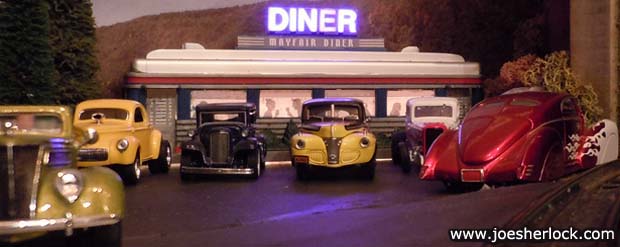
But the sign itself has deteriorated over the years. At first, it worked fine as soon as it was plugged in. Later, the plug and sign face connection needed to be bent a little to make it work. This year, the N and E barely lit up, even when bent. The electronics board was fine; the problem was the sign face itself.
I e-mailed Miller Engineering to see if I could buy a new sign face without all the circuitry. Chris at ME responded within the hour: "The replacement cost is $10, which includes the shipping. This cost is basically our cost as it is our policy not to make money on such problems. If you would like one, please send me your address and I will send you one. Once you have it up and running you can send payment."
A few days later, a new Diner sign arrived and it worked perfectly. I can't say enough good things about the fine folks at Miller Engineering, makers of Light Works USA scale model neon signs. (posted 12/6/12, permalink)
Murphy's Law On A Small Scale: On my O-gauge train layout, I run a Philadelphia PCC trolley car. One of the two bayonet-style bulbs used to light the interior of the trolley had burned-out. Thinking that replacing the bulb would be a snap, I disassembled the model streetcar, only to find that the lamp was stuck tightly. Finally, with the help of a ancient rubber jar-opener and a jeweler's screwdriver, I managed to extract the old bulb from its socket.
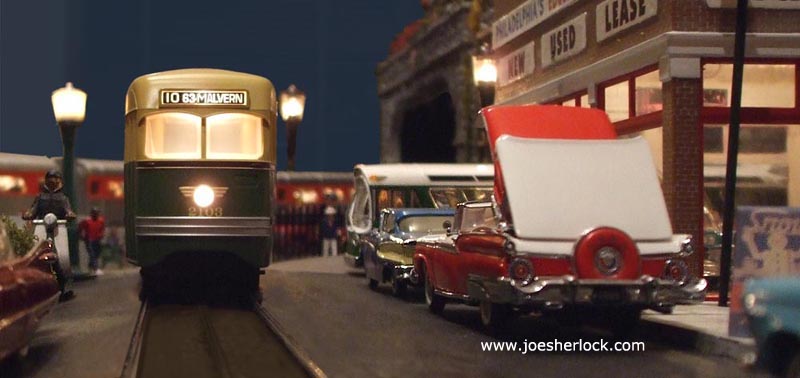
I had some extra 12-14v bayonet bulbs in the garage. I tried them and, at running voltages, they were extremely dim. I called the local Radio Shack and they were no help.
Then I remembered that I had another PCC-type trolley from the same manufacturer. I rummaged through storage boxes until I found it and dissembled it, removing the bulbs. Unfortunately, they were 14 volters as well. This older trolley (with Philadelphia SEPTA markings and color scheme) was a non-talker (not equipped with MTH Protosound) and apparently had a higher-voltage can motor than my newer Philadelphia Transit Company talking version.
Yes, I could find 6-volt bayonet bulbs on the internet but they were sold in packs of 30. Or there was a minimum order size of $20-35. Luckily, the good folks at Whistle Stop Trains in East Portland, were willing to physically test bulbs for me (while I waited on the phone) until they found one that burned brightly at 6 volts. I drove to their shop, bought the two-dollar item and, after retuning home, installed it. It works fine and I'm now back in business.
Whoever thought that something as simple as bulb replacement could be so time-consuming and complicated? Thanks to Charlie at Whistle Stop for the exceptional service. My miniature transit company will be ready to resume operations when the train layout goes up next month. (posted 10/17/12, permalink)
Hope It Arrives In Time For Christmas: I've been very fond of Entenmann's, especially their chocolate-covered donuts. (I had two of them yesterday morning, in fact. Yum.)
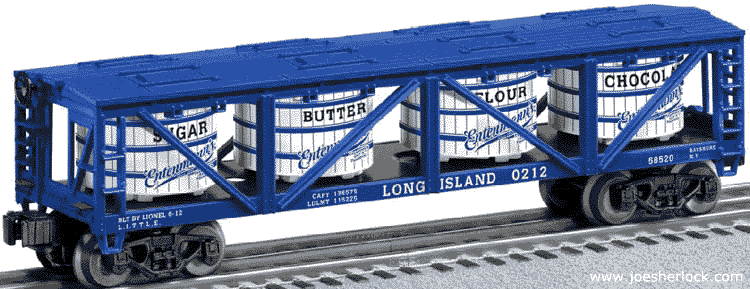
I just ordered a special blue and white Lionel Entenmann's Commemorative vat car in O-gauge for my train layout. It is being offered by the Long Island Toy Train Locomotive Engineers (LITTLE). "Production of this car will be extremely limited to only those who purchase this car in advance," the LITTLE announcement proclaimed.
The Lionel-made freight car features die-cast metal sprung trucks, Entenmann's logo script on each of the four vats (sugar, butter, flour, chocolate) and will come in a unique Entenmann's-style white box with blue trim. It is supposed to ship in December.
Update: On December 1st, my Lionel Entenmann's Commemorative vat car in O-gauge arrived at my front door. The packaging was not the standard Lionel orange box with blue printing but rather an homage to a box of Entenmann's donuts:
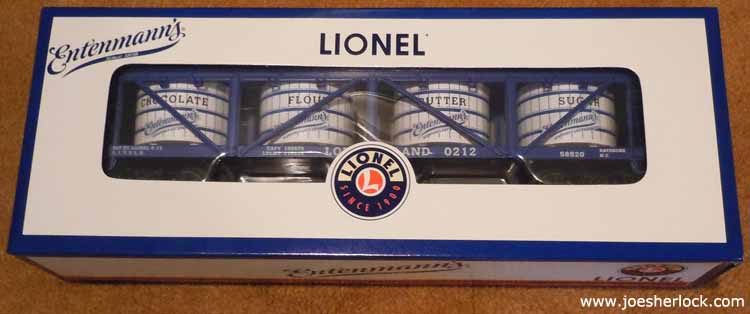
Very clever. (posted 4/6/12 and 12/4/12, permalink)
 Toyland Revisited: Recently, I was re-reading an excellent book, 'All Aboard,' the story of Lionel trains. This 1981 tome pointed out that Lionel's sales peaked in 1953 at $32.9 million/year. And declined quickly; by 1958, annual sales had dropped to $14.4 million. That was the first year since the depression that Lionel was unprofitable. While the author gives his reasons why Lionel declined in popularity, I have my own thoughts. Toyland Revisited: Recently, I was re-reading an excellent book, 'All Aboard,' the story of Lionel trains. This 1981 tome pointed out that Lionel's sales peaked in 1953 at $32.9 million/year. And declined quickly; by 1958, annual sales had dropped to $14.4 million. That was the first year since the depression that Lionel was unprofitable. While the author gives his reasons why Lionel declined in popularity, I have my own thoughts.
First of all, Lionel trains were expensive. In the 1951 Sears catalog, the lowest-priced Lionel ready-to-run set (steam locomotive & tender, three cars, oval of track and power supply) was $35.75. This was a lot of bucks in those days, probably equivalent to about $385 in 2021 dollars.
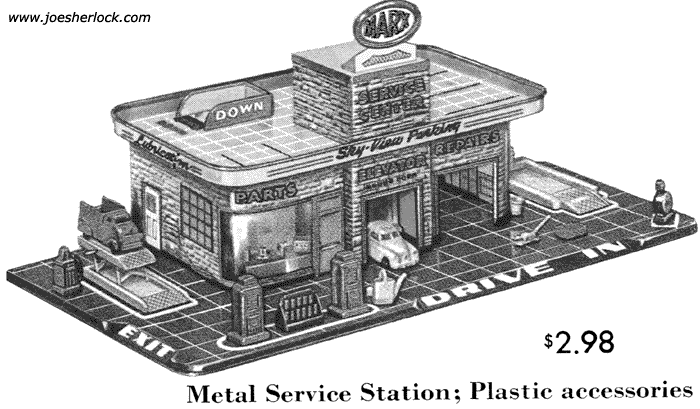
In 1951, a 59-piece cowboy ranch set was only $3.89. A Marx two-level metal service station (with parking on the upper level, a car elevator, 'down' ramp and several molded plastic cars) was only $2.98. And a Jeep pedal car could be had for $19.95. Meanwhile a ready-to-run Marx O-gauge train set (steam loco & tender, three cars, oval of track and power supply) was a mere $9.69 - 70% less than a similar Lionel set.
By 1953, Sears was offering its own brand of O-gauge - Happi-Time (later rebranded as Allstate) - which offered similar features at one-half the price of a comparable Lionel train. Early post-war Marx trains were pretty lame compared with Lionel - mostly lithographed tin - but by the mid-1950s, Marx was producing some pretty decent stuff with detailed, injection-molded plastic bodies. And Marx's prices were still very low compared to those of Lionel.
Secondly, the increased popularity of smaller-sized HO scale trains - which took up less space - stole business from Lionel. The addition of some operating accessories and smoking steam engines made HO fun to play with. And HO layouts took up a heck-of-a-lot less room.
Then there were the battery-operated 'electronic' toys (things like space toys and robots) of the mid-Fifties which took a substantial share of the toy market. And let's not forget Matchbox cars, introduced in 1953. And all of those model cars and car kits from AMT, Revell and others. And those science and chemistry sets.
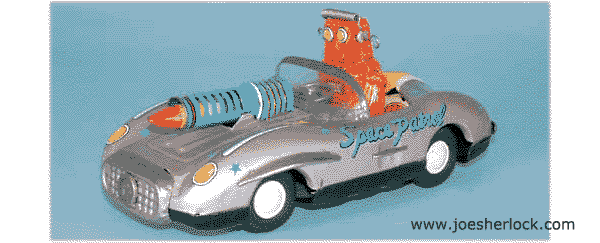
None of these products were a threat to Lionel in pre-WW II (and even early postwar) America when Lionel was king of the toy market. But they were picking up an ever-increasing share of the toy market. The Sears catalogs in the early 1950s, carried a lot of imported litho'd tin and clockwork toys from two of our former enemies - Germany and Japan. These were colorful, yet moderately-priced items. They also took a share of the available kiddie market. The there were portable radios, and 45-record players for older kids. And records. Rock and roll didn't help Lionel sales.
Finally, there was television. By 1959, the average family watched six hours of TV daily. Taking away time formerly used to build layouts and play with trains. But the final nail in Lionel's coffin was road race sets which began to appear in 1960 or so.
O-gauge trains almost disappeared until the 'revival' of the last 15 years or so. It's nice that they're back - with more manufacturers to supply a much greater variety of O-gauge train choices, including a revived Lionel. (posted 2/3/11, permalink)
A Big Thank You to the folks at Miller Engineering, makers of Light Works USA scale model neon signs. I have six of these signs on my model train layout. They are eye-catching and I get a lot of favorable comments from people who have seen the layout.
When I was putting up the trains this year, I couldn't get the animated Elephant Car Wash sign to work.
|
|
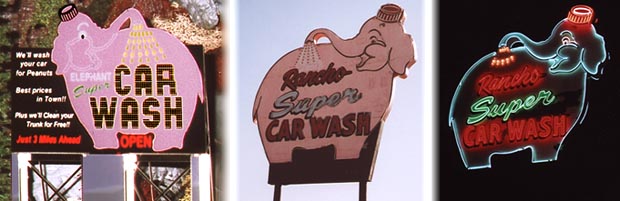
| The Elephant Car Wash animated sign on the front of the layout compares well with the real thing (day and night) in Rancho Mirage, CA. This animated sign was added to my train layout in late 2006. It also resembles the big one at 7th Avenue and Denny Way in Seattle: |
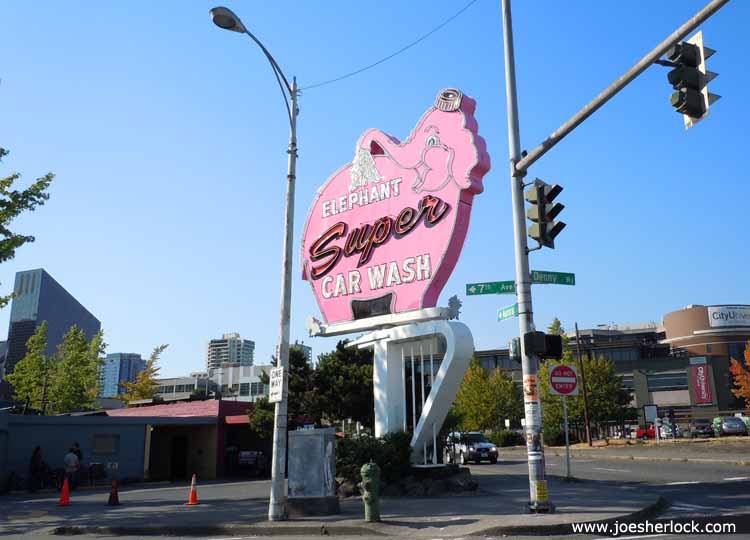
I wrote to Miller to see if they had any troubleshooting suggestions. It was quickly determined that the inverter on the circuit board was the problem. Bob Hawes of Miller wrote, "Please send back the defective part and we'll replace it free of charge." And they did, even though the sign was four years old. Thanks, Bob.
Is this a great example of customer care or what? I recommend this firm very highly.
You can see the sign, as well as other Light Works USA products on the YouTube video posted on the main page of my train layout website.
The Elephant Car Wash sequence starts at 1:46 in the video. (posted 11/24/10, permalink)
Another Dead Brand: Lionel Trains has announced that the end of 2010 will also mark the end of K-Line products.
K-Line was always positioned as an economy brand in the O-gauge train market, the successor to the old Marx line of trains. In fact, K-Line got its start with some of the old plastic Marx Train tooling.
When K-Line Trains went bankrupt in 2005, Lionel acquired it. But now, the O-gauge market is shrinking, because of the economy and the aging of the customer base.
In an interview with Classic Toy Trains, Jerry Calabrese, Lionel's chief executive officer said that K-Line had a good following and clever products, but ultimately Lionel could not make the numbers work for its value-priced line and "needed to focus its time and energy on areas with more growth potential."
Sadly, low-priced trains and accessories are quickly becoming things of the past. Williams, another supplier of budget O-gauge trains was acquired by Bachmann Industries in 2007. The first thing Bachmann did was raise prices, just as Atlas did when they acquired Industrial Rail - another maker of low-priced O-gauge stuff - in 2006. In 2002, I purchased an Industrial Rail O-gauge reversing trolley car for $30. The Atlas version now sells for $85 and up.
Lionel is also moving away from O-gauge trains that real people can afford.
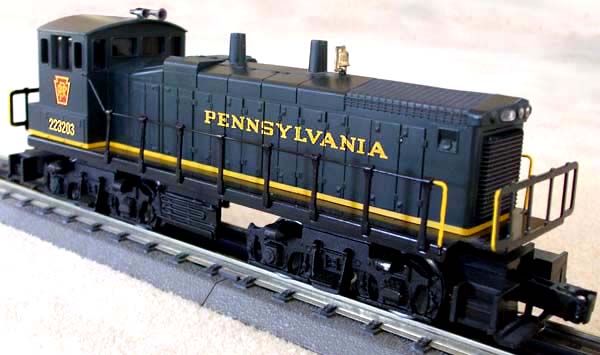
I have several K-Line items on my model train layout, including a Pennsylvania Railroad Electro-Motive MP-15 diesel yard switcher. In 2000, I bought it new as a 'set' with a PRR red caboose for $77.21. Unfortunately, those days are long gone; so is Davis Trains of Milford, Ohio - the hobby retailer that sold it to me. (posted 10/8/10, permalink)
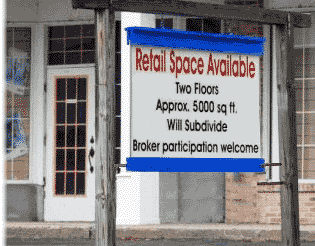 End Of The Line: Purkey's Toy Trains of Sykesville, MD closed its doors earlier this year. Owner Wiley Purkey cited many reasons including "the worst recession since the Great Depression." End Of The Line: Purkey's Toy Trains of Sykesville, MD closed its doors earlier this year. Owner Wiley Purkey cited many reasons including "the worst recession since the Great Depression."
He also pointed out that "train enthusiasts are getting older. The average age is early to mid-fifties, and kids are getting into trains at too slow a pace to replace the number getting out. Wiley thinks that maybe the kids aren't interested because they don't see much of the real thing anymore."
There's also what Purkey considers the general difficulty of running a business, especially retail, in Maryland. "The business climate in Maryland is unfriendly, to say the least. Small businesses in Maryland have had at least five taxes increased in the past two years. And with all the things that are balanced on the backs of business owners, I don't think you can make a living in retail in Maryland anymore, outside of the big-box mentality."
But Wiley said that the problems are "large and national." "I believe we're in the process of morphing into an information-based society. Away from a commodity society. Information is only good if people are buying and selling commodities. Information, just for the sake of information, is valueless. Everybody's social networking. Facebooking and Twittering about nothing. These people are not contributing. They're not building. Billions of dollars are being wasted on people going, 'Look at my stuff, look at my stuff.'
Everybody's selling, and nobody's buying. And that's not sustainable." (posted 7/14/10, permalink)
 Who Knew? The late Gary Coleman was a model train enthusiast and had quite a collection. Who Knew? The late Gary Coleman was a model train enthusiast and had quite a collection.
He had a large N scale layout and also reportedly collected HO scale stuff as well as Lionel.
Gary worked for a couple of train shops in Southern California and Colorado.
His Denver and Rio Grande Western Railroad themed layout was featured in a 1990 issue of Railroad Model Craftsman.
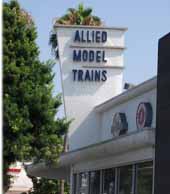
According to TMZ, the former child actor originally planned to leave almost all his worldly possessions to three model train shop stores, Allied Model Trains, The Original Whistle Stop, and The Train Shack in LA. (posted 6/16/10, permalink)
All Aboard: At Christmas time, stories about trains (toy trains, model railroading, The Polar Express and Thomas the Tank Engine) move to the forefront in the minds of many wanna-be railroad engineers - young and old.
Thomas the Tank Engine is the most widely-known fictional locomotive in the world. Thomas is based on the books written by an English cleric, Reverend Wilbert Awdry. He wrote the first one in 1945, basing it on stories he made up to entertain his children.
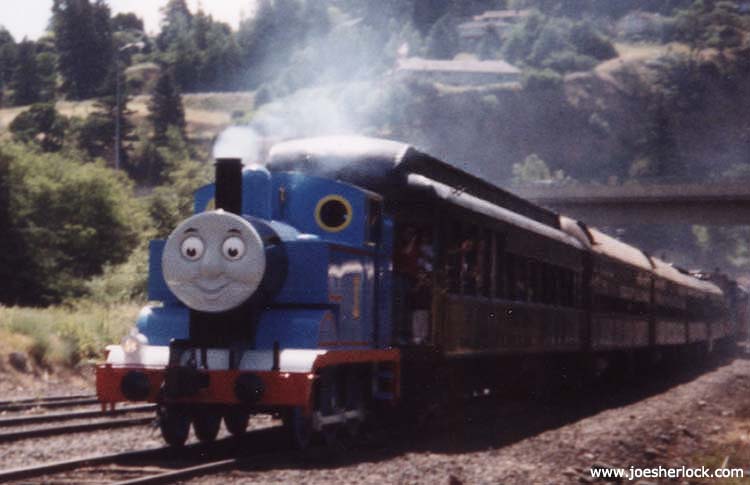
Most people know Thomas and his friends from the television series produced using handmade O-gauge model trains filmed on 70+ detailed sets in a hangar-sized studio. Each set is about 16 foot x 20 foot in size. Much of the show's quality is due to the special 35-mm movie camera used to film it. The camera incorporates an inverted periscope and can get down to within 1 inch of the track. The depth of field is an incredible one inch to infinity.
Sales of Thomas merchandise reportedly top $2 billion annually.
More about the Thomas juggernaut, including a personal encounter, can be found here. (posted 12/7/09, permalink)
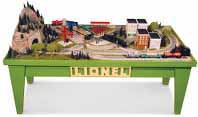 Hire Me Instead: The 2009 Hammacher Schlemmer holiday gift catalogue arrived last week. This year, HS is offering 'The Genuine Lionel Store Display Diorama'. It is "inspired by the lavish department store window displays of the 1950s." Hire Me Instead: The 2009 Hammacher Schlemmer holiday gift catalogue arrived last week. This year, HS is offering 'The Genuine Lionel Store Display Diorama'. It is "inspired by the lavish department store window displays of the 1950s."
The layout includes a single train - a basic Lionel New York Central Flyer locomotive and rolling stock, an eighty-watt transformer and a figure eight loop of track. The train layout is 4-foot by 8 foot with a small mountain and a few buildings.
Yours for $12,000. Shipping extra.
Hey ... for a lot less than that, I'll build you a much better 4x8 layout with two trains (passenger and freight) and a working point-to-point trolley line. And a big mountain. Plus lit buildings, flashing crossing signals, working streetlights and vehicles.
I've already built such a layout for my grandson. He loves it. Contact me real soon if you want pre-Christmas delivery. (posted 11/9/09, permalink)
How Not To Start A Business: Regular readers of my blog know that I'm a fan of small business and would probably enjoy traveling back in time and having a cocktail with George F. Babbitt at a plush hotel bar in downtown Zenith whilst discussing Boosterism.
As someone who has owned and successfully operated a few businesses, I always want new ones to succeed. I'm a fan. Sometimes though, you can't save them from themselves.
Recently, I read an article about a new business in my area - a model train hobby shop, no less - which is less than five miles from my house. It has been open for three months. I drive past its location almost every day yet I had no idea it even existed. I'm a model train enthusiast and try to keep current on the hobby. But I had heard nary a peep about this new store.
While I wish this new establishment the best of luck, I fear that it won't make it. This firm suffers from six major problems ... (more >>>)
 Train Wreck: Another train-centric hobby shop, III Rail Trains of Coon Rapids, MN, is closing down after 17 years. Here is an excerpt from its website explaining the closure: "After much thought to what is taking place in our economy, the constant rise in operating costs ... the huge spike in credit card service charges from the banks, the unexpected dropping of all direct dealers' ability to purchase direct from Lionel and forcing all ex-dealers to negotiate with and depend on a wholesaler to supply product at a higher cost …" Train Wreck: Another train-centric hobby shop, III Rail Trains of Coon Rapids, MN, is closing down after 17 years. Here is an excerpt from its website explaining the closure: "After much thought to what is taking place in our economy, the constant rise in operating costs ... the huge spike in credit card service charges from the banks, the unexpected dropping of all direct dealers' ability to purchase direct from Lionel and forcing all ex-dealers to negotiate with and depend on a wholesaler to supply product at a higher cost …"
Lionel's new dealer policy apparently allows only the largest (10 to 15) mega-dealers to buy direct. Smaller hobby shops (Lionel Authorized Value Added Dealers) must purchase from distributors or megas-dealers. Discounts for small hobby shops will most likely be substantially reduced, making their survival a bigger struggle.
Of course, Lionel is doing this in order to reduce expenses, hoping for savings in warehouse, sales and inventory costs. The downside - a big one - is that Lionel will become yet another step removed from the ultimate customer and will have less feel for what customers want. Distributors will "manage" inventory more ruthlessly which will result in fewer offerings at the retail level. In response, formerly-loyal Lionel dealers will stock more competitors' product.
In its announcement, Lionel apparently failed to use the words "customer" or "hobbyist" anywhere. Recently, Lionel CEO Jerry Calabrese has made it very clear that marketing to mass merchandisers is now a priority. I guess that stripped-down, low margin starter sets will be available at Target, K-Mart, et al while the specialty, high-margin stuff will disappear.
And this is a recipe for success - how?
I'm just glad that Whistle Stop Trains in Portland is still around. And that MTH Electric Trains is continuing to expanding its O-gauge offerings. (posted 3/23/09, permalink)
Off The Rails: Germany's legendary model train manufacturer, Märklin, has filed for bankruptcy. In addition to its well known HO-scale line, Märklin GmbH also produces G-scale LGB garden railway trains.
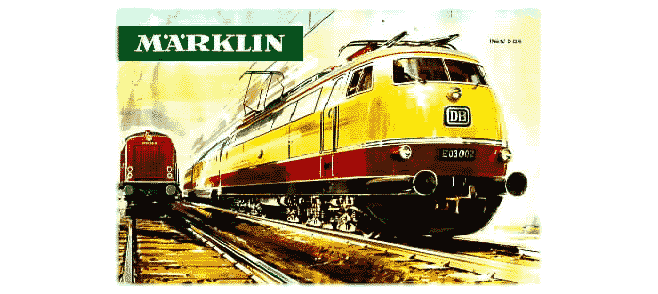
I remember seeing Märklin in hobby shops as a 12 year-old. The German locos and cars looked very exotic to my never-left-the-U.S. eyes. The trains were quite expensive, even in the mid-1950s. Märklin's catalogs were exquisite and colorful. Even though I never bought anything - Märklin trains were waaaay beyond my limited income from cutting neighbor's lawns, I studied the catalogs endlessly.
Märklin is based in the Swabian town of Göppingen, in Germany's southwest, but also has operations in Hungary. The firm started in 1859 as a small factory producing dollhouse kitchens. In 1891, it began manufacturing model trains and, in 1935, introduced HO-scale models.
The company had 2008 sales of $165 million but struggled to make payroll for its 650 employees. Kingsbridge Capital of Britain and New York investment bank Goldman Sachs bought Märklin in 2006. That takeover failed to solve credit problems that had plagued the company since 2004. Märklin closed a major factory in 2007 - part of a downsizing that led to the loss of 400 jobs. (posted 2/11/09, permalink)
Disgusted With Lionel: When I put up my Christmas train layout in 2008, I could not get the Lionel animated kiddie swing set to work. After screwing around with it for an hour, I finally discovered that the internal resistor which keeps the swing speed at a reasonable rate was apparently fried. If I jumped it electrically, the swing set went supersonic - even at a low voltage input.
So ... this unit, which I purchased less than two years ago, is basically junk after - I dunno - 40 hours running time.
Add this incident to my experience with the Lionel Automatic Gateman which required constant repairs, jammed often (despite a lot of adjustment and lubrication) and died after only three years. I bought a replacement which - so far - is working OK.
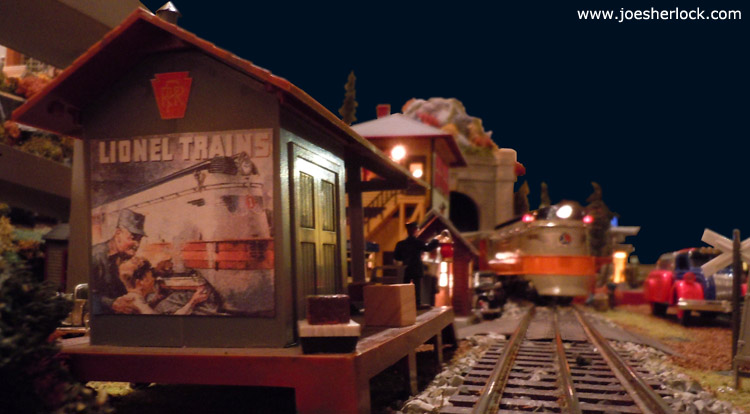
My Lionel Pumping Station which came from the factory with the World's Worst Solder Joints. And I've had many years of soldering experience.
I am never again buying anything with the Lionel brand on it. I have had more trouble with Lionel-made crap than any other brand of O-gauge railroading product.
I have reinstalled the MTH flagpole in the swing set's place on the layout. The flag-waving device is over eight years old and still works just fine. As do all my other MTH trains and accessories. (posted 11/12/08, permalink)
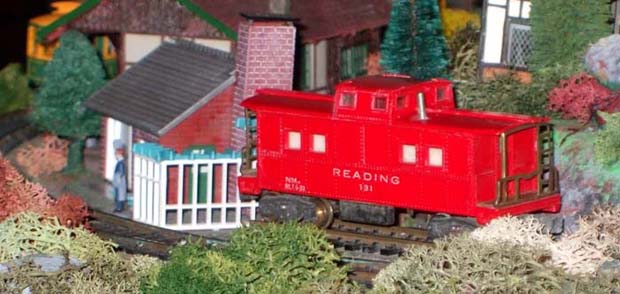
Caboose Story: On the mountain section of my train layout, next to the HO trolley tracks, is a lone Reading caboose. This sturdy, red HO scale car was made by A.C. Gilbert Co. and is the only remnant of an A.C. Gilbert HO freight set my dad bought for me in 1951.
The lighted interior has the original bulb and it still works - 57 years later. (posted 1/16/08, permalink)
The Train Has Left The Station: Mountain Trains and Hobbies of Manchester, NH, a landmark city hobby store popular with model train enthusiasts, closed its doors after more than a quarter century in business. The rise of video games and related electronic pursuits, along with less interest in model-building, have all made the industry a tough go. Lack of parking and a crime-ridden downtown have also been mentioned as possible contributors.
It's a shame; this was a wonderful place staffed by friendly, helpful folks. They had a large and fascinating operational train layout in the front window.
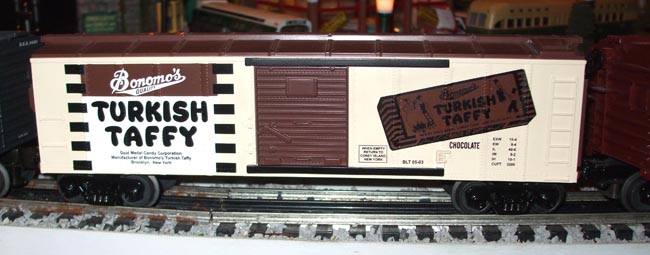
I visited in 2004 and bought an O-gauge Bonomo's Turkish Taffy boxcar. (Bonomo's was a staple in the candy rack when I was growing up.) In fact, I have the boxcar on my floor layout freight consist right now. (posted 10/10/07, permalink)
Model Train Market Data: There are some interesting market data in the recent Lionel bankruptcy plan. For instance, Lionel estimates there are 300,000 model train consumers in the United States who spend $300 million a year on the hobby.
HO is the most popular gauge, followed by O-gauge. The O-gauge market is about $100 mm. Lionel sales were $62,154,000 in 2006. Over the past few years, Lionel has grown at 9%/year.
Competitor MTH Trains is estimated to have $30 mm in annual sales, while Lionel's other competitors, Williams, Atlas O and Weaver, together earn 5 to 10 million dollars a year. Ancient rocker Neil Young owns 20% of Lionel (aka - Train Acquisition LLC). (posted 6/6/07, permalink)
Chugging Into History: K-Line Electric Trains - maker of O-gauge toy trains - is no more. Lionel is taking control of the K-Line brand, its tooling, its inventory of unsold products and other assets from Sanda Kan Industrial, the Chinese manufacturer that was K-Line’s principal supplier of trains and related products. Under a licensing agreement, Lionel will market and sell K-Line products as part of the Lionel line.
K-Line filed for Chapter 11 bankruptcy protection in August, 2005 and dismissed most of its employees in December.
Meanwhile, Lionel itself is still in bankruptcy itself. The O-gauge train industry seems very unhealthy these days.
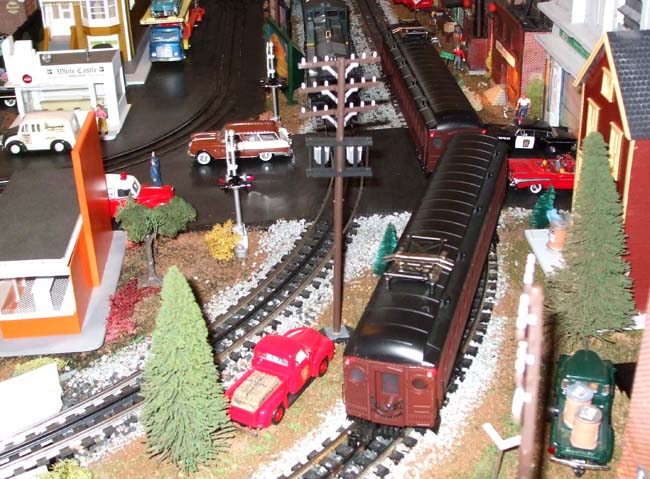
I have several K-Line items, including a PRR EMD yard diesel, a nice set of K-Line PRR 'Spirit of St. Louis' passenger cars and a Pennsy commuter MU set and some accessories. All can probably still be repaired, if needed, at a local hobby shop. So I hope. (posted 6/12/06, permalink
Rocky Rails: In August, K-Line Trains - maker of O-gauge toy and model trains - filed for chapter 11 bankruptcy protection. Earlier, both Lionel and K-Line reported that a settlement had been reached concerning a lawsuit filed against K-Line, accusing the company of wrongly incorporating Lionel technology into its products.
Lionel claimed that documents found on a computer taken from the home of one of its engineers, who has since been fired, showed that he was supplying K-Line with information about Lionel speed-control circuits, a starter-set transformer, and an entry-level sound system. But the agreement apparently fell apart.
Lionel is also operating in bankruptcy.
If you have model trains, you might - for authenticity's sake - want to put a scale-model courthouse on your layout. (posted 10/10/05, permalink)
Investment On Rails: An article in the New York Times suggests that the Lionel over-and-under set - a notoriously unpopular 1960 offering featuring O-gauge trains running on trestles above a matching HO train set - may now be worth $100,000. A popular price guide from 12 years ago lists a value of $9,500 for the same set. That's a pretty fantastic rate of return - far above any U.S. stock index. (hat tip - Kris Sundberg, posted 6/10/05)
At The Movies: 'The Polar Express' cost $170 million to produce and $125 million for marketing, and characterized its late 2004 opening weekend as "significantly below industry expectations." The movie grossed $23.5 million in its first weekend, well behind the $51 million notched by 'The Incredibles' in its second weekend. $295 million for a train flick!! And my wife thinks I spend a lot of money on my O-gauge trains! (posted 11/24/04)
Derailed: Toy train maker Lionel filed for bankruptcy (again) in late 2004 because it couldn't pay a $40.8 million judgment after a court found it guilty of obtaining stolen drawings and plans from the subcontractor of competitor, MTH Electric Trains. The judge also ordered Lionel to stop selling 20 different products. Lionel listed $55 million in debts, including $30 million to what appears to be a South Korean subcontractor, and assets of $42 million.
"Lionel's own misconduct in stealing a competitor's trade secrets has led to its downfall," said a lawyer for MTH. "Good businessmen do not operate the way Lionel did." Mike Wolf, owner of MTH, said his company had been hurt badly by the Lionel piracy, leading the company to cut the jobs of more than half of its staff over the past four years. MTH's revenue declined from $60 million to $30 million.
Otto Vondrak of Railroad.net writes, "Apparently this bankruptcy is only one issue affecting (Lionel) right now. Hoping to cash in on the publicity connected with the new Warner Bros. animated movie The Polar Express, Lionel is releasing a set based on the trains illustrated in the movie. While pre-sale response has been terrific, there are now doubts as to whether Lionel can meet production demands and have sets delivered in time for the holidays.
What's more, many orders are being turned away because it is feared demand cannot be met. Lionel is missing out on a huge opportunity to capitalize on nostalgia and reintroduce a generation of young people to the hobby of model trains."
I'm not an expert on the toy train market but I find it hard to believe that stolen drawings alone could cause such a precipitous drop in sales for MTH. Or any substantial sales increase for Lionel. From various visits to hobby shops, my impression is that MTH outsells Lionel. And MTH has expanded its line even more in its just-issued 2005 catalog. MTH is entering the HO train market as well and will begin offering product by Spring 2005.
Maybe the sales drop is because the entire O-gauge train market is collapsing. Interest in toy trains dwindled in the 1970s but picked up again when many baby boomers began collecting train sets again as deep-pocketed adults during the 1980s. "A lot of our business is baby boom men basically rekindling their memories. That could be a problem, as far as those guys going away," said Andy Edelman, vice president for marketing at MTH Electric Trains.
As far as I can tell, toy train manufacturers have failed to draw post-boomer adults into the hobby. Maybe now that pre-boomers and boomers are getting older and downsizing, they are buying fewer trains. Or have already purchased everything they want.
This same phenomenon happened in the collectible model car market. In the 1980s and early 1990s, small companies were producing limited-edition, expensive models of automobiles in 1:43 scale. Described as "Hummels for guys," models were mostly of cars from 1935-1965.
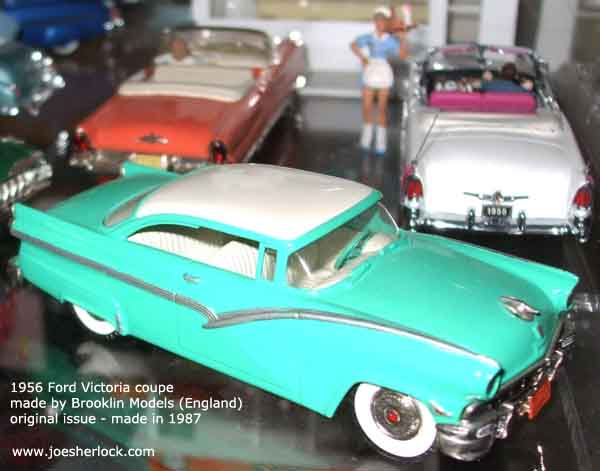
Brooklin, Western Models, SMTS and Mini-Marque - all based in England - dominated the market. Later, Franklin Mint and Matchbox got in the game, adding expensive little models to their line. Then the market got saturated - people had bought every model they wanted and their display cases were full. Matchbox Collectibles disappeared, Franklin Mint downsized and many of the smaller producers either closed or became shadows of their former selves.
A large number of retailers that sold such models shuttered their premises. (Ironically, Brooklin's founder, John Hall, considered by some to be the 'father' of the collectible model car business, started his venture in the late 1970s to make some nice-looking vehicles suitable for his friends' Lionel train layouts.)
I like model trains and am partial to MTH. I own several of their products and have found them to be very well-made. MTH is disliked by some Lionel collectors because of its aggressive marketing and legal tactics. And owner Mike Wolf is very outspoken. But MTH is widely credited with bringing innovations into a hobby that had changed very little since the 1950s. The company also introduced a high-quality budget line, RailKing, forcing competitors to lower prices.
Never a mere knock-off house, MTH produced items not done by others including the Aerotrain, PCC streamlined trolley cars, New York subway/elevated trains and, coming in 2005, a replica of the Leland-Detroit monorail set of the 1930s.
I wish MTH well and hope that the toy train industry survives and recovers. (posted 11/23/04, permalink)
Money Train: Union Pacific has sued model train manufacturers in an attempt to collect royalties for every railroad name in its portfolio, including many long-gone roadnames, like the Denver & Rio Grande and the Missouri-Kansas-Texas (Katy Line). UP has already filed suit against Lionel (O-gauge) and Athern (HO-gauge), causing much ill will toward Union Pacific from train hobbyists.
UP admits that the royalty payments will not cover UP's costs of administration and enforcement. This stupid move is further proof that there are too many corporate lawyers with not enough to do.
'Playing With Trains: A Passion Beyond Scale' is a book by Sam Posey. My friend and fellow car/train nut, Ray from Pennsylvania, sent me a copy. I wanted to like it. The title is great and Sam Posey is a legendary car guy - a former Indianapolis and Grand Prix driver turned Emmy-winning ABC sportscaster. He likes trains. And he's about my age. The book is about his love of model trains, beginning with the Lionel sets he had as a child and culminating in his 16-year task of recreating the Colorado Midland Railway in HO scale. Posey estimates that he spent 6,000 hours building the layout. This does not include the professionals he engaged to help build his dream.
The first half of the book is about the layout itself. The second half includes visits to other modeler's layouts, a horrible train trip to Florida on Amtrak and conversations with a train wholesaler and a magazine publisher. While Posey is a good writer and clearly conveys his love of model trains, I found the second half far less engaging than the first part of the book. It's almost as though his editor said, "Sam, you need more pages." I also found his initial quest to get information about HO trains to be somewhat naive and lame, especially for a worldly businessman. But, for me, the biggest problem with the book is that there are no photos of trains or layouts. In this case, each picture would be truly worth a thousand words.
I have a set of six videos from TM Video featuring O-gauge model layouts. Each layout featured included an interview with the modeler in which he described his goals, dreams and techniques in model railroading. I found these most interesting and helpful. I got many ideas for my own layout which I built in 2000. Other firms produce videos for other scales, including HO.
To me, such videos are a thousand times more useful and entertaining than this book. Sorry, Sam. (posted 10/16/04, permalink)
A Cradle To Rock: As a youngster, I enjoyed playing with Lionel trains during the Christmas holidays. My trains ran on a train 'platform' built by my dad. In early post-WWII Philadelphia, it was common for neighborhood dads to compete with one another to build the largest, or most spectacular model train layout for their sons to enjoy. These layouts had landscaping, mountains, tunnels, buildings and operating accessories such as crossing gates, coal car dumpers and the like.
As a college student, I spent part of Christmas break one year helping to construct a large, Lionel layout in a friend's basement. Over the years, I built several layouts first for my younger brother, later for my children.
In 2000, I put together a large, three-level train layout for use at Christmastime because my grandson is a train fan. The layout is on casters and is moved from garage storage into the living room using ramps. Once in place, it must be rotated 90 degrees. Since the layout weighs several hundred pounds, this is not an easy task. (In 2003, I didn't put it up because of a back injury.)
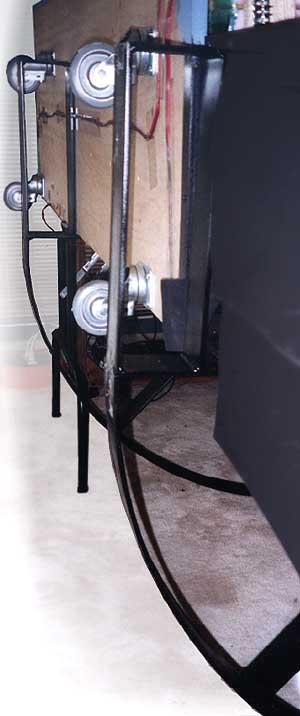
In the summer of 2004, I designed a cradle consisting of two 'rockers' (fabricated from 1/4-inch thick steel plate) connected with wood cross braces. In early November, we brought the train platform inside and used the new cradle to rotate it. It worked spectacularly and we are now out of the weightlifting business. (posted 11/20/04)
HO-Scale Birth Control: Marklin, a 145-year-old German maker of model trains, is packing a condom alongside a blue, HO-scale freight car emblazoned with the name of Blausiegel, a German condom maker. The model boxcar and condom, which retail for $35, are packaged in a sleek, brushed-metal container the size of a cigar box. The packaging offers no instructions on placing the railroad car on a track but does have illustrated instructions on using the condom.
Important Disclaimer: There are no condoms or condom ads on my train layout.
Other Pages Of Interest
copyright 2004-20 - Joseph M. Sherlock - All applicable rights reserved
Disclaimer
The facts presented on this website are based on my best guesses and my substantially faulty geezer memory. The opinions expressed herein are strictly those of the author and are protected by the U.S. Constitution. Probably.
Spelling, punctuation and syntax errors are cheerfully repaired when I find them; grudgingly fixed when you do.
If I have slandered any brands of automobiles, either expressly or inadvertently, they're most likely crap cars and deserve it. Automobile manufacturers should be aware that they always have the option of trying to change my mind by providing me with vehicles to test drive.
If I have slandered any people or corporations, either expressly or inadvertently, they should buy me strong drinks (and an expensive meal) and try to prove to me that they're not the jerks I've portrayed them to be. If you're buying, I'm willing to listen.
Don't be shy - try a bribe. It might help.
|
|