Finance & The Economy -2010
More recent 'Finance & The Economy' postings can be found here.
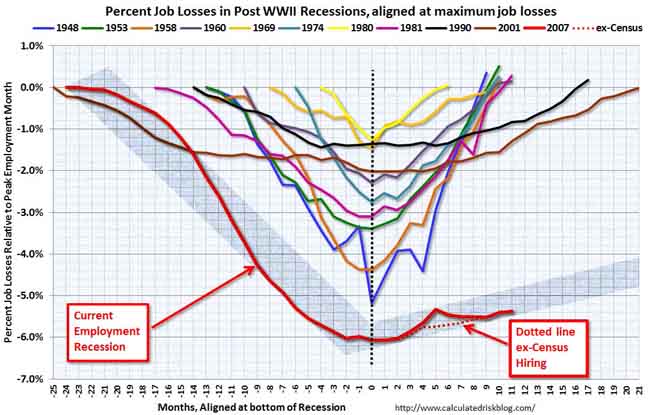
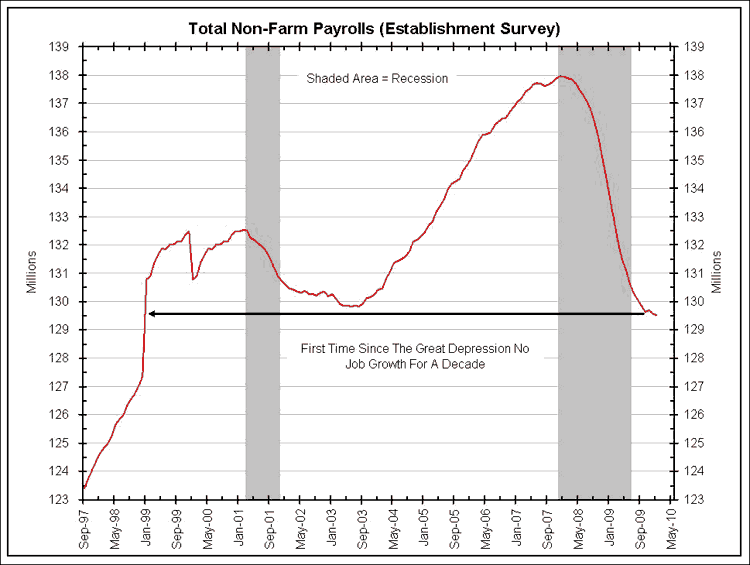
Check It Out: For some time now, I've been predicting that the economic recovery graph will not be the historical bounce-back V-shape we're used to seeing but rather an anemic check-mark shaped one.
Here's the beginning of that long, low, slow check-mark:
Fundamental, Structural Economic Shift: Fritz over at Ace has posited an interesting theory about long-term negative trends in the U.S. economy.
"We here in the U.S. have spent the last 25 years or so talking about our transformation from a manufacturing economy to a "knowledge" economy. In retrospect, we appear to have been trying to make a virtue out of an inevitable trend. The problem is, consumers by and large don't buy "knowledge" - they buy tangible things."
 More: "To a large extent, we can consider the last 30 years to have been a "meta-bubble" in which we burned through a lot of different types of "credit" in building a lifestyle and a level of general public wealth at all levels (leftist naysayers notwithstanding) never before seen in the world. More: "To a large extent, we can consider the last 30 years to have been a "meta-bubble" in which we burned through a lot of different types of "credit" in building a lifestyle and a level of general public wealth at all levels (leftist naysayers notwithstanding) never before seen in the world.
That meta-bubble started deflating 10 years ago, with the tech crash of 2000. We have continued to pump up other bubbles (e.g., subprime loans, the great equity drawdown, the college education bubble, QE2) to maintain that lifestyle, but they all keep popping as well. We are a bit like the cartoon character falling from a plane who - after two or three parachutes have failed - keeps digging through his parachute pack, hoping to find something to stop the descent and coming up with increasingly improbably - but inevitably useless - objects.
And beneath our feet, the unforgiving ground rushes up ever faster."
Personally, I'm more optimistic but agree that bubble-making exuberance will reappear - it always does. Stupid banks will always extend credit to slugs if some Federal agency is the co-signer (houses, college loans, sometimes even vehicles) and the U.S. has created a hostile environment for manufacturers, driving business offshore. Much of it will probably never return.
As to "knowledge-centered selling" - a big buzzword back in 1995 or thereabouts, only consultants and financial newsletter publishers made any money in that arena. Both markets have withered in recent years; the tanking economy caused businesses and individuals to cut back on such discretionary purchases.
And the rest of the "let's use our brains, not our brawn" stuff - code writing, engineering, data analysis, number crunching, etc. - went to India where they will rent their very fine brainpower to U.S. firms at far lower salaries. (posted 12/7/10, permalink)
"The Summer's Gone And All The Flowers Are Dying." It's not all Guinness and soda bread these days over on the Emerald Isle.

The once-admired Celtic Tiger is full of economic turmoil. In good times, the Irish government, like many others, wouldn't restrain itself to spending within the limits of what it collected. And, despite signs of shifting economic conditions and an impending real estate bubble, the Irish bureaucrats never adjusted, guessing that the European Union would make everything alright.
Ireland, always a poor country, took the first steps to liberalize its economy in the late 1980s, by cutting corporate taxes. This encouraged foreign investment and soon drug manufacturers and technology firms were flocking to Eire.
They were impressed by its well-educated native workforce. The Irish had neither the language nor cultural barriers of east Asians and could communicate readily with Americans and Europeans. Familiar names such as Pfizer, Dell, Hewlett Packard, IBM, Microsoft, Wyeth Labs Eli Lily and Fort Dodge Laboratories all developed a significant presence on the island. Chipmaker Intel is now Ireland's largest private employer.
I first visited Ireland in 1995. When I returned two years later, it was a changed place. The cars on the road were much nicer (fewer Ford Escort beaters, more new Mercedes-Benzes), the people were better dressed, the number of restaurants had increased significantly and there were construction cranes everywhere.

Patrick Honohan of Trinity College Dublin has written, "Until about 2000, the growth had been on a secure export-led basis, underpinned by wage restraint. However, from about 2000 the character of the growth changed: a property price and construction bubble took hold. This boom sustained employment and output growth until 2007 despite a loss of wage competitiveness. The banks fueled the boom, especially from 2003, exposing themselves both to funding and solvency pressures."
A three-fold increase in average real property prices from 1994 to 2006 was the highest boom in any advanced economy in recent times. When the U.S., got a bad cold from its real estate bubble, Ireland got pneumonia.
In late 2006, construction, "which had employed over 13% of the workforce – began to contract." Wage restraint of the past had long ago died and Ireland, with a minimum wage of over $11.50, had become uncompetitive in the world market. Unemployment is now 13.6%.
By mid-2008, the Irish export sector had to cope with a sharp slide in the value of the Pound – the currency of neighboring Britain and Northern Ireland. The domestic retail sector hit a slump "as households crossed the border into Northern Ireland to take advantage of suddenly lower prices."
The collapse of the real estate bubble caused banks to become functionally insolvent. No wonder. Honohan has noted, "From 2003 on, banks continued to ease loan conditions such as maximum loan-to-value ratios. These continued to fall right through 2006 despite the increasingly evident vulnerability of the bubble. ... Banks funded the surging loan demand by huge foreign borrowings. By early 2008, net foreign borrowing by Irish banks had jumped to over 60% of GDP from 10% in 2003."
At present, banks from the UK, Germany, the U.S. and France have the largest exposure to Ireland's financial crisis. U.S. Banks are on the hook for almost $115 billion.
The anticipated EU bailout will come at a stiff price: higher taxes, fewer citizen services and a slow and lengthy recovery. Government expenditures will be about 54% of Irish GDP in 2010 - so expect cuts to be severe.
The Irish are vowing to maintain their 12.5% corporate tax rate. This is a smart move, because that's what created the Celtic Tiger in the first place. (Unrestrained real estate speculation gave the tiger its near-death experience.) Job creation should again become a priority to help the tiger return to health and, eventually, greatness.
"But come ye back when summer's in the meadow ..." (posted 11/26/10, permalink)
Cardboard Trade: During our Walla Walla trip last month, we purchased home several cases of local wine. Examining the cardboard boxes, I noticed that some of them came from outside the U.S.
Two came from Mexico (Monterrey and Apodaca) and another proclaimed "glass and carton made in China."

International trade presents a serious dilemma for any business owner. Do you 'buy local' and charge a premium?
Or, do you shoot for the best price/quality bottles and cartons you can, sending those glass worker and carton maker jobs offshore? And hope that the lower costs will give you some extra profit dollars to spend on marketing and promotion, so that you can grow your own company and hire more people here in the U.S.
The answer isn't easy but I suspect that you'll get more wine customers by having great looking-labels, professional promotional materials and a smart marketing campaign than you will by proclaiming your use of American bottles and home state packaging materials.
In the 1980s, my plastics manufacturing company imported some components from Asia. Prices were one-third to one-fifth of U.S. pricing and quality was 90% there. We used our own Q.C. people to inspect and repair anything not up-to-snuff and still saved quite a bit of money. Our customers didn't care - they bought from us because of our reputation. And we stood behind everything, including the foreign-made components.
I do know that, without those low-cost foreign parts, we couldn't compete. By using overseas pieces selectively, we gained business, which caused us to hire more people at our firm.
I'm pretty sure that it was a net gain for America. (posted 11/1/10, permalink)
Damn Near A Depression: The economy is like a gravely-ill patient in an ICU - the worst may be over but there has been a near-death experience followed by a long and painful path toward recovery. Bill McBride of Calculated Risk has posted a graph: 'Percent Job Losses During Recessions, aligned at Bottom'.
As the graph clearly indicates, this is the worst recession since World War II - by a long shot - in both depth and duration.
Some vital signs are improving (private sector jobs are slowly increasing, rail traffic is rising, hotel occupancy rates are climbing, online advertising is on an uptick, corporate profits are on the rise) but the patient remains very, very sick. (posted 9/7/10, permalink)
Recovery Summer = Summer Of George: In June, Barack Obama and Joe Biden declared this to be the 'Recovery Summer'. It is turning out to be more like the 1997 Seinfeld episode, the 'Summer of George', initially described by George Costanza as "time to taste the fruits and let the juices drip down my chin."
Just as things didn't work out so well for Mr. Costanza, Messrs. Obama and Biden are learning that the economy's legs "have sustained extensive trauma. Apparently your body was in a state of advanced atrophy, due to a period of extreme inactivity and abuse. But with a lot of hard work and a little bit of luck, I think there's a good chance you may, one day, walk again."
Neither businessmen nor consumers have any confidence in the policies being pursued by the Obama administration. Weekly jobless claims are getting worse and worse. The economy is still quite sick.
According to Karl, "You don't really need loans to set up and operate a small business. You need guts and the willingness to work long hours and take risk. Personally. Yes, you'll grow slower. So? You'll own what you earn - it will be yours, not the bank's. You'll keep your opportunities to yourself, instead of always looking over your shoulder. And when the time comes to expand, whether it be by buying more stuff, adding employees or moving to a new, larger location you'll do it based on cash flow, not on whether you can make the minimum payment on some note and pray that you'll be able to roll it over at reasonable interest rates in a year or two."
Well, maybe that's true for zero-inventory, minimal accounts receivable businesses like consulting or accounting. Or certain wholesale businesses, where margins are so high that cash management is irrelevant. In the early days of the software business, you packaged 80¢ worth of floppy disks and a $10 manual and sold it for $400. In such a scenario, it was easy to self-fund expansion with the $389.20 which remained. That's how Adobe, Microsoft and Intuit could grow so quickly in the 1980s. Alas, most businesses aren't so lucky.
When I owned a manufacturing business, I needed to borrow funds in order to grow. Most 'ordinary' manufacturing businesses have 30-35% gross profit and net 10% or less before taxes. A 30% growth in sales means that you have to buy 30% more raw material inventory, you'll be carrying 30% more work-in-process and finished goods inventory and your accounts payable will jump by 30% as will your receivables.
Your increase in profit dollars (at 10% NPBT) won't be nearly enough cover these increased expenses. Therefore, if you can't secure working capital, you can't grow and your business will stagnate. Others - your competitors - will step up and meet customer needs.
What would Mr. Denninger have you do when a good customer calls and wants to double this month's order? Without access to funding, a small business may not be able to handle increased orders.
While my manufacturing business was in the upper quartile of its peers for both net profit before taxes and return on total investment, we borrowed more every year. Our debt as a percentage of net worth was continually decreasing - a healthy condition - but we couldn't grow without access to capital.
|
|
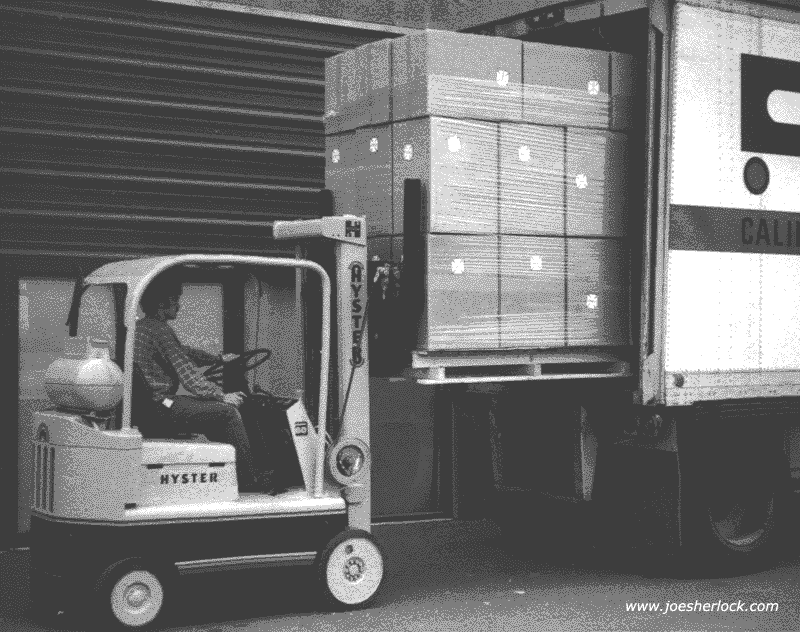
| Loading a trailer with freshly-manuactured, boxed Plexiglas store fixtures on shrink-wrapped pallets in 1985, using our ancient 1955 yellow Hyster forklift in Tangent, Oregon.
In '85, two of our larger display fixture accounts increased their orders by 309% and 71% respectively. Without access to loans, we couldn't have fulfilled their requirements and would have lost both accounts.
|
When small businesses are denied credit (capital access), the economy stays dead in the water.
William Dunkelberg, chief economist at the National Federation of Independent Businesses, has commented: "While news about the economy has been positive for two or three quarters, small business owners remain quite pessimistic about the future for the economy. The Optimism Index has been below 90 for 18 consecutive months and below 90 in all but four months since the recession started in January of 2008."
Dunkelberg noted, "Since small firms produce half the private sector GDP, it is hard to envision a sustained recovery without their participation. Once the gains from inventory rebuilding are exhausted, it is hard to see what will fuel growth. Small firm capital spending is at 35 year low levels and plans for future expenditures are equally low. Plus, hiring plans remain 'negative' as more firms still plan reductions than increases in their employment)."
Small businesses overwhelmingly continue to cite 'Poor Sales' as their number one problem.
Bank lending has declined each month for the past year. According to Federal Reserve statistics, U.S. banks have reduced corporate lending in each of the last 12 months. While TARP and other government programs kept dead banks afloat, these programs ensured that the institutions saved with others' money would not aggressively lend for a long time. NY Fed President William C. Dudley has noted that "the banking system is still under significant stress. This is particularly the case for small- and medium-sized banks that have significant exposure to commercial real estate loans. This stress means that banks have been slow to ease credit standards as the economy has moved from recession to recovery."
Until the banking mess is straightened out and lending institutions begin to loosen their purse strings, the economic recovery will be anemic. I predict a check-mark-shaped recovery rather than a V-shape. (posted 5/31/10, permalink)
Bleak Opportunities: Here's a scary fact: One of every five men 25 to 54 isn't working. According to an article in the Wall Street Journal, "Even more alarming, the jobs that many of these men, or those like them, once had in construction, factories and offices aren't coming back."
"A good guess … is that when the economy recovers five years from now, one in six men who are 25 to 54 will not be working," Lawrence Summers, the president's economic adviser, said recently.
In the past, technological changes simply shifted opportunity within the U.S. "As farm jobs were eliminated by mechanization, factories hired more. As factories increased productivity and moved work offshore, more Americans got jobs in health care and other services."
Nothing in any textbook says that the supply and demand for workers will intersect at a wage that is socially acceptable. Therein lies the problem.
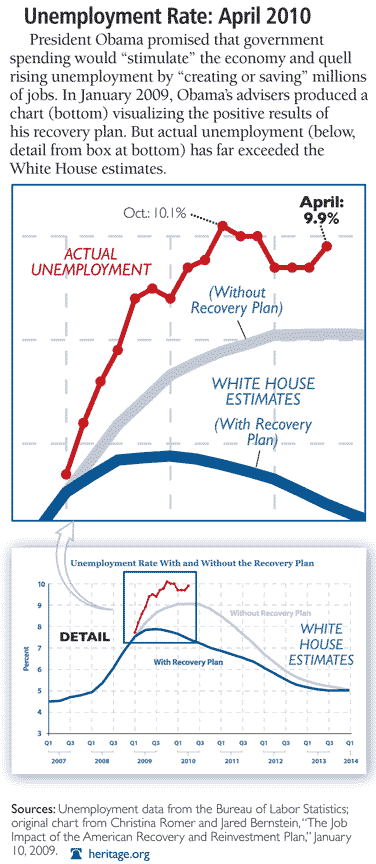
Bill McBride of Calculated Risk has added, "In the early '80s, the 27 weeks or more unemployed peaked at 2.9 million or 2.6% of the civilian labor force. In April 2010, there were 6.72 million people unemployed for 27 weeks or more, or 4.34% of the labor force. This is significantly higher than during earlier periods."
At present, the 'official' national unemployment rate is 9.9% but if "you also include all of the people who are still discouraged and all of those who want to work full time but can find only part-time work, that unemployment rate in April was 17.1%, a rate that has increased since the beginning of the year."
Low-paying jobs in restaurants, nursing homes and health clubs are hard to automate or outsource will probably always be around. But how do we make America the Land of Opportunity again?
There are no easy answers. (posted 5/24/10, permalink)
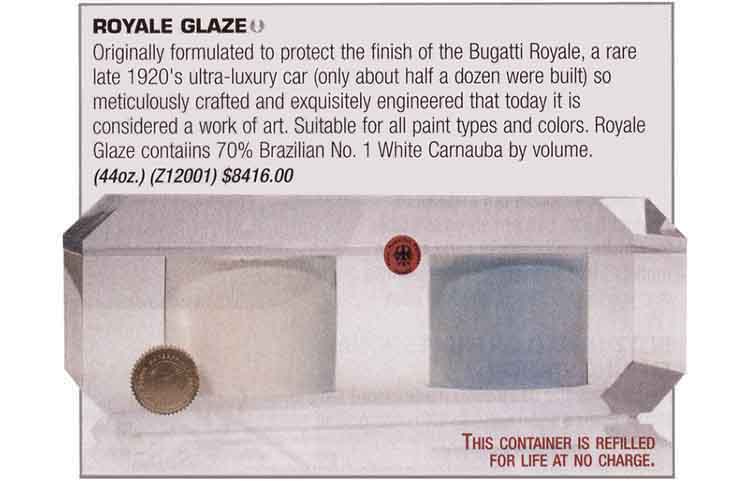
I Hereby Declare The Recession Over: When people are paying over $8,400 for a can of car wax, things must be getting better.
Yeah, you get free refills but it'll never pay off unless you're obsessively waxing an H-Class battleship. (posted 5/4/2010, permalink)
Thirst War: In Cascade Locks (a small Oregon town on the Columbia River), where unemployment is at 18% and high school students have to be bussed 25 miles to the closest school because the local one closed this year due to lack of tax base, Nestle wants to build a bottled water plant.
The residents are all for it - the plant would create construction jobs and 50 permanent positions making it instantly the city's biggest employer. The company would also become the city's biggest taxpayer generating close to $1 million for little Cascade Locks.
But Portland environmental groups are upset and want the evil plant stopped. You know ... that Portland, Oregon - a city which never saw a bioswale, bike path, homeless camp or streetcar that it didn't like.
Greenies are disturbed because the plant will use those wasteful and environmentally-deadly plastic bottles which people may not necessarily recycle - so, they are not just viscous killers, they are single-use killers as well. Plus, people might toss partly full water bottles out of their speeding, energy-wasting malevolent automobiles, injuring or killing an innocent bicyclist, spotted owl or homeless bum. Instead, these eco-overlords want people to drink from taps or use old WW II canteens. And patch their worn-out Birkenstocks with old chewing gum (Black Jack is the best, I'm told).
Furthermore, there is a state-run fish hatchery in Cascade Locks which raises endangered sockeye salmon that are trucked in from Idaho's Snake River. The city of Cascade Locks proposes to replace the diverted water for the bottling plant with some of the city's own well water. The state of Oregon is currently "testing the well-water to see if it's suitable for the fish." Oregon has never worried whether this same water was suitable for the residents, who've been drinking it for years. I suppose they're not as important as fish.
I think I'll just sit back and watch this fight, although I am pro-business and generally sympathetic to thirsty people. Hmmmm. Might Nestle would be interested in my bottled water idea? (posted 4/14/10, permalink)
California Sunset: In March, the last car rolled off the production lines at California's sole auto plant, the New United Motor Manufacturing (NUMMI) plant in Fremont. The plant began 25 years ago as a joint venture between Toyota Motor Corp. and General Motors Co. in a shuttered GM plant which had produced Camaros and Firebirds.
Once the Golden State, California used to be a beehive of industrial activity. Ford had assembly plants in Richmond, Long Beach and Milpitas. My 1939 Plymouth was made on a Los Angeles assembly line. Many World War II soldiers who tasted California on their way to the Pacific, relocated after the war, driving the great California post-war boom. That hot Golden State economy was fueled by industrial jobs - mostly manufacturing, including high dollar items like cars, electronics and aircraft.
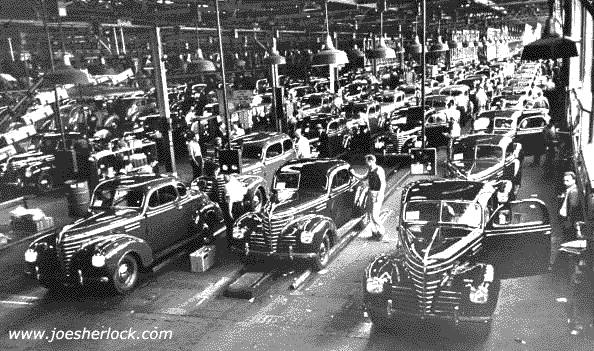
Today, the factories are largely gone, driven out by the high cost of doing business and by a left-wing legislature that doesn't seem to care, making ghost towns and ghettos of once-thriving metropolises.
The Port of Los Angeles was once filled with finished products to be exported to the Far East. Today, much of LA's exported product is waste paper - shipped to Asia to be converted to cardboard boxes for manufactured goods exported to the United States.
In its quest to find more tax revenue, California is now proposing to decimate its giant wine industry by increasing the state excise tax on a 750-ml bottle of wine from four cents to more than five dollars. Trader Joe's may soon be selling Seven Buck Chuck. (posted 4/8/10, permalink)
Deadbeats Rising: Capital One's U.S. credit-card defaults rose again in January. The annualized net charge-off rate - debts the company believes it will never collect - rose to 10.41% in January from 10.14% in December. During 2006, the charge-off rate was down in the 3-4% range.
Capital One is the third-largest U.S. issuer of Visa-branded credit cards, and the fifth-largest issuer of MasterCards.
In related news, a recent study by John Burns Real Estate Consulting "estimates that five million houses and condominiums on which mortgages are now delinquent will go through foreclosure or related procedures that put them on the market over the next few years. That would represent the bulk of the estimated 7.7 million households behind on their mortgage payments."
Finally, credit information firm TransUnion has reported that "mortgage loan delinquency (the ratio of borrowers 60 or more days past due) increased for the 12th straight quarter, hitting an all-time national average high of 6.89% for the fourth quarter of 2009. This quarter marks the first time the mortgage delinquency rate increase did not decelerate after doing so for three consecutive periods.
This statistic, which is traditionally seen as a precursor to foreclosure, increased 10.24% from the previous quarter's 6.25% average. Year-over-year, mortgage borrower delinquency is up approximately 50%." (posted 2/17/10, permalink)
How To Have A Jobless Recovery: If you believe that a picture is worth a thousand words, these scary graphs speak volumes. Here's just one:
In recessions before 1990, the time from pre-recession job peak to full job recovery was 18-24 months. In 1990, it took over 30 months. The next recession - 2001 - required over 46 months. It now appears that the present recession may not experience a complete employment recovery cycle for 4-5 years. Why is the time to recover from job losses getting longer and longer? I would suggest three possible causes:
1. The proliferation of outsourcing. Faced with ever increasing labor regulation, upwardly spiraling health care costs (due in large part to the unreformed U.S. tort system) and the like, many companies are reducing their workforce by subcontracting - often overseas.
The annual cost of mandated Federal regulations for firms with less than 20 employees is estimated at almost $8,000. This does not include the cost of training poorly-educated, near illiterate graduates - products of our failing unionized education system, which turns out near-illiterate slackers with little knowledge and even less work ethic.
2. Elimination of customer services. In the short run, it improves profitability and productivity (revenue/employee). In the long run, it eats away at the very thing which made the particular company successful.
Financial advisor Malcolm Berko has observed, "We have to wait longer at Walgreens to pay for a purchase because there's only one person at the register rather than two. Customer service at American Express is now an oxymoron because AMEX employs fewer people. It now takes 18 minutes to make a reservation at the Embassy Suites; there are fewer open checkout lines at Costco; you have to wait 45 minutes to make a phone reservation with Southwest Airlines; and it's nearly impossible to locate sales help at Dillard's."
3. Job consolidation due to mergers, buyouts and "right-sizing" in a quest for quick profits and mythical "synergy." George Washington's Blog has noted that "newspapers have largely driven themselves into the ground with their never-ending drive for higher profits, which led to a reduction in news bureaus, investigation and real reporting, and an increase in reliance on government and corporate press releases."
Sean Paul Kelley has added, "I don't buy all the hype that the internet is even the primary culprit of the demise of journalism. The primary culprit is the same as it is all over the country, in every industry and in government: equity extraction. Let me explain, in short: when executives expect unrealistic profits of 20% and higher per annum on businesses something has got to give. It's an unnatural and unsustainable growth rate."
Malcolm Berko has also written, "Observers suggest this is a consequence of a Congress that counterproductively devotes excessive energy, time and resources on health care legislation to cover 13% of the population, rather than healing a very sick economy with 10.2% unemployment, which is a more immediate and serious imperative. ... Frankly, I believe that 7 to 8% unemployment may become the future norm."
When you run your banking system like a dysfunctional three-card monte game, outsource all your subassemblies to Asia, close plants in Indiana and Michigan and move production to Mexico, close your California tech support center and open one in Bangladore - and vote for a government whose policies make the aforementioned business actions seem sensible ... this is the result. (posted 2/10/10, permalink)
Low Expectations: Chicago banking icon Northern Trust Company was founded in 1889 and its conservative policies have served it well over the years. I've had dealings with this bank and have always been impressed by its professionalism. The bank counts over 20% of the U.S.'s wealthiest families as its clients, so - when it has something to say - it's usually worth listening to. Northern Trust has made some pessimistic predictions for 2010:
• "Consumer spending will continue to be constrained by sluggish labor market conditions, reduction in net worth, and tight credit conditions. Discretionary spending will be the missing element in the lukewarm pace of consumer spending."
• "The unemployment rate is projected to peak at about 10.5% in the middle of 2010. The soft growth projections for 2010 arising from financial headwinds, the reduced workweek, and the structural change in the economy due to a massive slump in housing and auto demand will result in sluggish hiring in most of next year."
• "The major challenge for U.S. policymakers at the moment is the lack of credit creation in the economy. Although the Fed has provided an extraordinary amount of monetary accommodation since the financial crisis unfolded in the summer of 2007, this Fed-created credit has not been transformed into credit for the private sector. Thus, a significant credit contraction is underway."
• "Currently, financial institutions appear to be adequately capitalized, but they are reluctant to extend credit. They remain wary because of continued challenges associated with home mortgages, anticipated losses from commercial real estate loans, further defaults of auto loans and credit cards and uncertainty about the new regulatory capital requirements."
Sum up: Don't break out the party hats and balloons just yet. (posted 1/18/10, permalink)
More postings about finance and the economy can be found here.
Other Pages Of Interest
copyright 2010-15 - Joseph M. Sherlock - All applicable rights reserved
|
Disclaimer
The facts presented in this blog are based on my best guesses and my substantially faulty geezer memory. The opinions expressed herein are strictly those of the author and are protected by the U.S. Constitution. Probably.
Spelling, punctuation and syntax errors are cheerfully repaired when I find them; grudgingly fixed when you do.
If I have slandered any brands of automobiles, either expressly or inadvertently, they're most likely crap cars and deserve it. Automobile manufacturers should be aware that they always have the option of giving me free cars to try and change my mind.
If I have slandered any people or corporations in this blog, either expressly or inadvertently, they should buy me strong drinks (and an expensive meal) and try to prove to me that they're not the jerks I've portrayed them to be. If you're buying, I'm willing to listen.
Don't be shy - try a bribe. It might help.
|
| |