|
The Perfect Storm
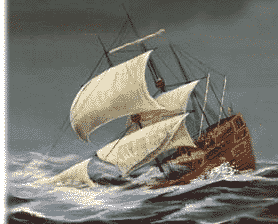 Remember the message of the movie? Commercial fishing always has its risks but can become deadly when several dangers combine to form a catastrophic situation. Remember the message of the movie? Commercial fishing always has its risks but can become deadly when several dangers combine to form a catastrophic situation.
The auto business is also a risky proposition (sailing across an ocean whose bottom is littered with the coral-infested bones of Studebaker, Kaiser, DeLorean and many other corporate vessels) but the merging of five disparate factors is now building to a cataclysmic, virulent climax - The Perfect Storm:
1. Start with a bad product mix. Or, more accurately, the wrong product mix for the times. You'd think that the Big 2.5 would have learned after the oil crises of 1973 and 1980. But they didn't. Instead of offering a balanced portfolio of vehicles, they continually reacted to the fad-of-the-moment, developing products which were no longer desirable by the time they were introduced.
Unlike their Asian competitors, Detroit never developed true flexible manufacturing facilities, investing instead in a 'truck plant' or a 'Cadillac factory' or a 'Lincoln facility' or a location that could only produce Taurus/Sable sedans.
2. Thirty years of pissing-off customers has finally come home to roost. In the 1980s, disgruntled buyers of GM, Ford or Chrysler products could only broadcast their displeasure at work or in bars. Today, the web has changed all that. Angry buyers put up websites. Or vent their spleens online in various forums. Bad news now spreads like wildfire.
In today's world, information technology provides potential buyers with a cornucopia of information about the vehicles they're considering.
Meanwhile, the sons and daughters of those angry '70s and '80s buyers continue to remember Pop's Bad Experience (from many dinner table rants) and buy Asian.
3. The Americanization of Japanese cars is now complete. In the 1960s and 70s, Japanese cars offered weird styling and lacked those little American luxury touches. No longer. A Lexus is more 'loaded' than a Cadillac DTS. Asian cars now look American ... or is it that American cars now look more Asian?
Many Asian-badged offerings have a higher domestic manufactured content than their Yankee-badged counterparts. Buicks are made in Canada; Chevy Aveos are produced in Korea. The Toyota Avalon has 70 percent American content, the Honda Civic - 75 percent, but Chrysler's PT Cruiser is only at 60 percent. The Ford Fusion and its Mercury Milan and Lincoln MKZ clones are made in Mexico. "American" brands, badges and emblems mean nothing anymore.
4. There is a convergence of features in automobiles. Once upon a time, a Cadillac or Lincoln would be equipped with convenience and luxury items not found in a lowly Ford or Chevy. No more - the differences between cheap cars and expensive cars are disappearing. Almost every car now has power windows; great sound systems are a frequently-specified option on entry-level vehicles. Safety features like multiple air bags, traction control, stability control and the like are no longer the province of Volvo and its haughty competitors. Hyundai and other low-priced vehicles now offer a myriad of safety features.
Meanwhile, luxury brands like Lincoln have "decontented" (a Detroit euphemism for "cheapened") their offerings over the last 10 years.
Once upon a time, people who purchased luxury cars were assured that their car would be better made than a lesser vehicle. If that were ever true, it is no longer. J. D. Power reports that the gap between luxury and non-luxury brands is narrowing. This year, owners reported an average 213 problems per 100 vehicles for premium brands, only 15 fewer than for mainstream brands.
5. Look-alike styling has become the Great Equalizer. If "racing influences the breed", isn't the fact that cars are getting more and more alike except for badges/decals representative of what NASCAR has been like for the past 15 years?
When I was growing up, I could identify makes of cars from 1/4 mile away. Now I can't tell the difference when I see them 10 feet away in a parking lot - unless I look at the emblem. So, how can I impress my neighbor with my new vehicle if he/she can't even tell what I'm driving? Or if his/her $18,000 ride has pretty much the same look and most of the luxury features as my $55,000 machine.
Summary: Detroit's business model of the past 60 years is no longer working. Hype and bullshit cannot compete with competence, product quality, manufacturing flexibility and the forward march of technology.
People buy cars based on facts and impressions. And we live in an age where a plethora of both is just a few mouse clicks away.
The storm has hit Detroit. And the ship is sinking. (posted 10/12/2006)
 Update: The View From The Precipice: "The stock of General Motors has dropped to the lowest point in (over 50 years). GM and Ford may be better able to do business under Chapter 11 protection," short-seller James Chanos of Kynikos Associates Ltd. said on Bloomberg Television. "One of the better things these companies could do is go bankrupt,'' quipped Chanos, whose mostly bearish hedge fund bet against Enron Corp. in 2001 prior to its bankruptcy. "I am not saying liquidate, but go bankrupt and reorganize. Then they would have a fighting chance.'' Update: The View From The Precipice: "The stock of General Motors has dropped to the lowest point in (over 50 years). GM and Ford may be better able to do business under Chapter 11 protection," short-seller James Chanos of Kynikos Associates Ltd. said on Bloomberg Television. "One of the better things these companies could do is go bankrupt,'' quipped Chanos, whose mostly bearish hedge fund bet against Enron Corp. in 2001 prior to its bankruptcy. "I am not saying liquidate, but go bankrupt and reorganize. Then they would have a fighting chance.''
GM had a working capital deficit of $10.9 billion at the end of the first quarter, while Ford's was $9.04 billion, according to data compiled by Bloomberg. Chanos said the companies' working capital positions are "dire'' and that investors focusing on their cash balances are being misled.
The company now has the smallest market capitalization in the Dow Jones Industrial Average, of which it has been a component since 1925. GM share price closed yesterday (6/30/08) at $11.50. Shares have traded as high as $43 over the past year. In April 2000, the stock hit $93.62/share.
Toyota is now worth roughly 25 times as much as GM.
All of the Detroit automakers are in trouble. Sales are dropping precipitously, especially large pickups and SUVs. As I wrote in The Perfect Storm (10/06): "Start with a bad product mix. Or, more accurately, the wrong product mix for the times. You'd think that the Big 2.5 would have learned after the oil crises of 1973 and 1980. But they didn't. Instead of offering a balanced portfolio of vehicles, they continually reacted to the fad-of-the-moment, developing products which were no longer desirable by the time they were introduced."
That said, I think Chrysler is in the worst shape in terms of product desirability. But GM is a close second with too many offerings and a generally unappealing mix - at least in the eyes of consumers. (The Corvette is great; Cadillac's CTS as well as Saturn's new offerings have been praised by the buff mags but have not sold especially well.) Ford has pared its costs and is adjusting its product portfolio; the question is: can it finish the job before it runs out of money.
The 24/7 Wall St. site offers bankruptcy odds on publicly-traded companies. (Chrysler is excluded because it's now private.) Betting on bankruptcies between now and the end of 2008, the odds "favor" airlines, publishing media and financial firms.
The most likely to go Chapter 11 are: AMR (American Airlines) - given a 1 in 2 chance. Followed by UAL (United Air; 1 in 4), Northwest (airline; 1:5), Gatehouse (newspapers; 1:5) and Delta (airline; 1:10). General Motors is down the pack at 1 in 25 odds, behind Lee Enterprises (newspapers; 1:15) and tied with Lehman Bros. (brokerage house), Continental (airline) and Wachovia (bank).
When my wife and I visited the Philadelphia area in 2006, it seemed half of the banks we saw were wearing Wachovia signs. The 6th and Chestnut branch - catty-cornered from historic Independence Hall - had badly rotted wood windowsills on the ground floor. I should have taken that as a sign that there was rot elsewhere at the mega-bank.
Ford is given a 1 in 35 chance of bankruptcy this year. That almost sounds optimistic, compared with these other troubled corporations.
In March of 2006, I reported that I and three of my fellow geezer car buddies were convinced that General Motors would eventually go bankrupt. We still are. All of us are business-oriented, having owned our own firms. One is a ex-employee of a Tier I supplier to Detroit.
Forget sophisticated cash flow analysis, reading the details of 10-K filings, etc. It's our gut feel - based on lack of good product, GM's severe and continuing misreading of the market, the number of GM cars seen in rental lots, the substantial off-price deals being offered on too-many models and the lack of interest by any of our friends - or their children - in owning anything made by The General. Another tip-off is the bankruptcy of several key Tier I suppliers. These and other suppliers will force price increases on GM - a company which can't seem to raise its own prices in the marketplace because of low perceived value by prospective customers. That makes the squeeze tighter. And the cash burn faster.
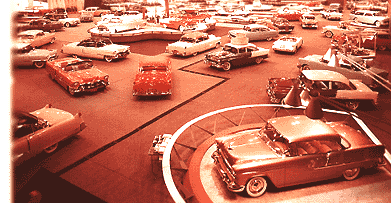 We blame the once-great auto giant's demise on numerous people: 1) GM's top management (not just Wagoner but everyone from Roger Smith forward), 2) the UAW (and GM's top management for caving into the UAW's ever-escalating demands over the last 25 years) and 3) every senior GM marketing, brand and product manager from 1980 forward. We blame the once-great auto giant's demise on numerous people: 1) GM's top management (not just Wagoner but everyone from Roger Smith forward), 2) the UAW (and GM's top management for caving into the UAW's ever-escalating demands over the last 25 years) and 3) every senior GM marketing, brand and product manager from 1980 forward.
We bemoan all of the major and costly misfires by General Motors over the past quarter century, including the mid-80s look-alike sedans, the Cimarron, the shrunken Cadillac fiasco of 1986, the Catera, the Allante, the death of Oldsmobile, the demise of the high-profit Rivera/Toronado/Eldorado trio, the marginalization of Pontiac, the irrelevance of Buick, the unfulfilled promises of the Saturn brand, etc. The cumulative effect of these mistakes is the severe erosion of GM's once-loyal customer base.
The only thing which might buy General Motors some time is if Chrysler goes belly up first. It is very possible that this would drain some of Chrysler's customer pool into GM's dry creek. (posted 7/1/08, permalink)
Update: What If ...? If McDonald's goes out of business tomorrow, will we all become vegetarians? Or starve? Of course not. We'll just trot across the street to Burger King. Or Arby's. Yes, there would be weeping and gnashing of teeth. McDonald's workers would lose their jobs - probably only for a short time, because Burger King et al will be hiring extra help to handle the increased volume of business. Bun and catsup suppliers who were tight with Mickey D will lose all their business - but, if they were smart, they'd already be selling to other fast food joints (it's called 'customer diversification') and will make up the lost business as other firms grow to fill the McD-sized gap.
Capitalism is a game of survival of the financially fittest and the most fleet of market-savvy foot. Corporate America is littered with the skeletons of companies whose offerings didn't change with the times - trolley car manufacturers, railroads, hat blockers, fitters of spats, corset firms, etc., etc. Or businesses that failed to keep up with competition and market trends - Mervyn's, Wilson's Leather, Studebaker, Tower Record stores, Bennigan's, IndyMac Bank, etc.
If GM and Chrysler shut their doors tomorrow, it will not be the end of America. People will still drive and buy cars. They'll just buy them from someone else. But these auto giants won't suddenly close. They'll file Chapter 11 first. And that may be a good thing. Robert Farago of TTAC thinks that GM will run out of cash by/before the end of 2008: "The Wall Street Journal reports that GM says "estimated liquidity during the remainder of 2008 will approach the minimum amount necessary to operate its business." So, essentially, unless GM get a federal bailed out by 12/31/08, they are going Chapter 11." Reuters reports that Chrysler is rapidly burning through cash and that the till may be empty by mid-2009. Sounds optimistic to me.
Neither GM nor Chrysler offer the kind of 'game changing' products required to survive. They could have developed them but made bad product decisions and didn't. This, combined with 30+ years of sub-par product quality, is why people are buying other brands, primarily ones with Asian badges. Unless someone forceful with an insanely great product plan, a Bucyrus-Erie 1850-B power shovel to dislodge top management and several Unimogs full of gold bullion steps forward, these two firms are beyond salvation. Some products (Jeep, Corvette, maybe Cadillac) could survive if the businesses were broken up but GM and Chrysler as we knew them are going the way of the dodo bird and the Caribbean monk seal.
TTAC has posted a well-written and insightful article written by a bankruptcy attorney titled, 'Why the GM/Cerberus/Chrysler Bailout is bad for taxpayers and doomed to fail without the benefits of a Chapter 11 filing for both Chrysler and GM.' I recommend that you read it.
I do not believe the current roasted ol' chestnut that "if GM and Chrysler go bankrupt, Ford will have to." If GM and Chrysler fail, many diehard American car buyers will head over to Ford showrooms, deserting The General and Mopar, with their dubious warranties and questionable futures. Ford has the best and broadest product line of The Detroit Three. And Ford's offerings keep getting better although its cash is getting depleted as well.
I'm not trying to minimize the effects of auto industry bankruptcies - there will be serious disruptions, especially in Michigan - but, in time, the car business will be healthier for it. Bailouts are not the answer ... capitalism must be allowed to run its course.
In a Wall Street Journal article, Holman W. Jenkins Jr. notes, "Let's not kid ourselves that a taxpayer rescue would be anything but a down payment on a never-ending bailout. ... With or without a taxpayer rescue or the ministrations of a bankruptcy court, breaking the labor monopoly is the step without which Detroit will remain the problem child of American industrial policy."
He concludes, "The stakes here are even bigger than they seem. Detroit's bad news could be America's worse news if the industry's year of living extra miserably starts the whole economy down the road to protectionism and taxpayer-financed industrial cronyism." (posted 11/10/08, permalink)
 Update: More Reasons Not To Invest In General Motors: Steven Spruiell of National Review has written, "Searching for bright spots, the Obama administration has seized upon the resurgent U.S. auto industry, and specifically on the bailed-out GM - which has posted its first profitable quarters since 2004 and looks set to relaunch itself as a public company this fall, just in time for the elections." Update: More Reasons Not To Invest In General Motors: Steven Spruiell of National Review has written, "Searching for bright spots, the Obama administration has seized upon the resurgent U.S. auto industry, and specifically on the bailed-out GM - which has posted its first profitable quarters since 2004 and looks set to relaunch itself as a public company this fall, just in time for the elections."
The problem is General Motors' accounting methods are so convoluted that it is very difficult to determine whether the company is truly profitable.
Accountants can twist the numbers to meet management's scenario du jour. It reminds me of the old vaudeville tailor joke: "You want a blue suit? Abe, turn on the blue light."
In the Financial Times, Tony Jackson has pointed out that GM is forecasting returns on its pension investments of around 8.5% a year.
Jackson has noted that such a prediction "stands in curious contrast to the conventional prudent assumption, which is that pension assets should give a risk-adjusted return equal to the yield on Treasury bonds. And the U.S. 10-year Treasury yield is now just 2.6%."
Let's not forget that the U.S. stock market has averaged 0% - zip, nada - over the past 11+ years. If I truly believed that my investments would average an 8.5% per year return, I'd probably be out shopping for a Bentley Continental GT ... which wouldn't help General Motors any.
"To put that from another angle, GM's annual payments to its U.S. pensioners are running at $9.3 billion. On U.S. fund assets of $85 billion, that ostensibly requires a return of 10.9%." Good luck with that.
Mr. Jackson draws this conclusion: "Emerging like a butterfly from the chrysalis of bankruptcy, GM is being excitedly touted as worth $60 billion-plus. But closer inspection of its gigantic pension fund suggests that in the long run, the business may be worth nothing at all." A big monetary junkyard ... so to speak.
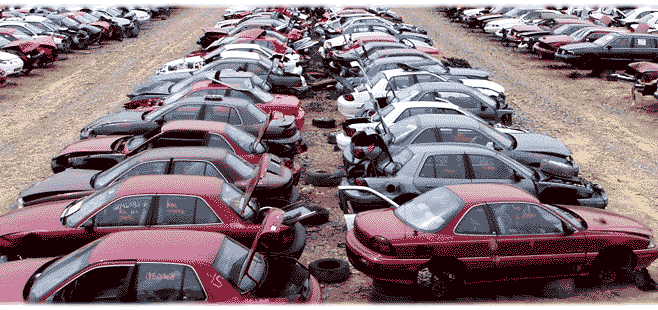
NRO's Spruiell wrote this about the bailout payback: "Amid misleading claims that GM has paid back all of its bailout money, it is important to keep in mind just how much government support the automakers received: Out of $50.7 billion in loans to GM, only $7 billion, or 13.8%, has been repaid. (If you believed GM's claim that it paid back its loans to the government in full, with interest and ahead of schedule, can you loan me some money?)
Chrysler got $10.7 billion, of which it has repaid $2 billion. And let's not forget about GMAC (now Ally Bank), GM's financing arm, which received $16.2 billion and has yet to repay any of it. GM rid itself of GMAC's problems by spinning it off shortly before declaring bankruptcy, but the money loaned to GMAC should count toward GM's bailout: If it hadn't been necessary to keep financing available to GM customers, GMAC probably would have been allowed to fail."
Mr. Spruiell concluded that "we are a long way from being able to say that the bailout "worked", much less that we wouldn't have been better off letting GM and Chrysler reorganize in bankruptcy without our help."
Jeez, I'm beginning to think that the appalling Tesla Motors may be a better investment than the General. (posted 10/1/10, permalink)
General Failure: I have just finished 'Overhaul: An Insider's Account of the Obama Administration's Emergency Rescue of the Auto Industry' by Steven Rattner; my review is posted here.
Citing many specific examples, Rattner's tome has decisively demonstrated that GM's management was clueless, insular and had no believable financial controls. He wrote that senior executives "spent 80% or their time gathering data and only 20% analyzing it."
Steve Rattner's Team Auto established a goal of not only rescuing a failing General Motors but also putting in place the right management to assure future success. Now that Team Auto is gone, things at GM seem to be reverting to the bad old days.
Over at AutoBlog, John McElroy is very concerned, noting that Mary Barra is now in charge of product development. "She's tasked with developing new cars faster and at lower cost. ... GM's new CEO Dan Akerson openly admits he's not a car guy and is clearly impatient with GM's product cadence. He wants things to move a lot faster, and he wants to take out a lot of cost. That's why he put Barra in charge."
Big companies have a tough time doing good product development hastily and inexpensively. And doing things "on the cheap" was a big factor in General Motors' past troubles.
McElroy concluded that Dan Akerson is "leading GM backing into the same place it came from - John Smale and Ron Zarrella mediocrity. In other words, he's running GM straight off a cliff. Mary Barra has no experience in product development.
It's a crying shame. Lutz had finally wrestled GM into starting to develop interesting cars, which Akerson is going to completely undo."
Peter De Lorenzo (AutoExtremist) has called CEO Dan Akerson and his team a "looming train wreck," noting that "Akerson insisted that GM has too many engines globally and he's going to 'fix' that. Uh, and he's basing that on what, exactly? Secondly, Akerson is quite certain that GM is spending too much time and money differentiating sheet metal between the divisional nameplates, when a little creative marketing would suffice.
Oh really?
The last guy who believed that at GM was John Smale and we all know how that turned out, don't we? The Smale 'Reign of Terror' (executed by his Chief Acolyte, Ron Zarrella) was so mind-numbingly wrong-headed that it ended up unleashing a string of products bristling with all of the P&G-infused, marketing-driven mumbo jumbo that the Smale/Zarrella brain trust could muster - revolving around the fundamental premise of it doesn't matter how good the product is, because brilliant marketing can overcome anything - and resulting in the most woefully uncompetitive and out-of-touch products in the market. Not only was it a complete disaster, it ultimately helped set the table for the most humiliating corporate bankruptcy in American history."
De Lorenzo concluded, "'Lt. Dan' is a corporate blunderbuss masquerading as a 'switched-on' visionary auto executive, except there's nothing visionary about the shallow reservoir of knowledge that this guy brings to the table every day. Instead, it just falls under the time-honored dictum of a little bit of knowledge is a very dangerous thing.
The Bottom Line?
Dan Akerson is the wrong guy, at the wrong time, at the wrong car company.
And as long as he's at the wheel, GM's long-term future is at risk."
America already bailed out GM once. If they fall into the pit again, let them climb out themselves. Or die. (posted 1/26/11, permalink)
 Auto Quote Of The Year, Perhaps: On May 31, VanillaDude posted a comment at The Truth About Cars on the auto bailouts. He wrote, "The auto bailout would not be an issue in the presidential election next year if the US economy improved enough to assure voters that the problems faced in 2008-2009 were behind us. It has not. Auto Quote Of The Year, Perhaps: On May 31, VanillaDude posted a comment at The Truth About Cars on the auto bailouts. He wrote, "The auto bailout would not be an issue in the presidential election next year if the US economy improved enough to assure voters that the problems faced in 2008-2009 were behind us. It has not.
The bailout would not be an issue in the presidential election next year if the loans were paid back. Another reason we will see this issue remain alive is because it reinforces the crony capitalism and crony unionism backroom deals the current administration continues to make in DC. One cannot call for shared sacrifices, yet continue to demonstrate that political connections with the right people avoids sacrifices. The bailout is another example of corrupt dealmaking.
The bailout was necessary. How it was handled exposed to voters how badly the Federal Government operates. It exposed voters to the corruption in DC. It demonstrated to voters how callously their taxed wages are flushed away without concern. It exposed the unfairness of an administration elected to reinforce fairness. It exposed the current administration's claims of openness and transparency as egregious lies.
TTAC can debate the success or the logic behind the amount of bailout money spent. We can debate if GM will survive, thanks to the bailout, and for how long.
But in a country where the Federal Government is demanding more daily decisions from us, when they inject government into our lives, our daily lives become more political – and that sucks. I long for a day when the government in DC returns to being an invisible partner in this country, not its nagging, stupid mother in law."
Well said.
Daniel Ikenson of the Cato Institute has written: "The auto industry wasn't rescued with the GM bailout. GM was 'rescued.' By rescuing GM, the government overrode market forces, and there are significant costs to assign for that. Witness the stagnant economy with 9.6% unemployment. ... Is it not plausible that businesses are sitting on their cash and not investing or hiring because of the fear inspired by the government interventions starting with the bank and auto bailouts? It's more than plausible. The regime uncertainty that persists to this day was spawned by the GM bailout and other interventions."
When the auto bailouts were first proposed by the Bush Administration, I was against them. It seemed unfair to Ford, that Chrysler and General Motors would get funding, protection and backing from the government, which could put FoMoCo at a competitive disadvantage.
 In October '08, when the bankruptcies of automakers were first being discussed and there was hand-wringing over the "catastrophic collapse of the entire industry", I opined that, if McDonald's went out of business tomorrow, we wouldn't become vegetarians. Or starve. We'd simply trot across the street to Burger King. Or Arby's. In October '08, when the bankruptcies of automakers were first being discussed and there was hand-wringing over the "catastrophic collapse of the entire industry", I opined that, if McDonald's went out of business tomorrow, we wouldn't become vegetarians. Or starve. We'd simply trot across the street to Burger King. Or Arby's.
Yes, there would be weeping and gnashing of teeth. McDonald's workers would lose their jobs - probably only for a short time, because Burger King et al would soon be hiring extra help to handle the increased volume of business. Bun and catsup suppliers who were tight with Mickey D would lose all their business - but, if they were smart, they'd already be selling to other fast food joints (it's called 'customer diversification') and would quickly make up the lost business as other firms grew to fill the McD-sized gap.
In the same way, auto buyers would still buy vehicles. They just might be Fords or some Asian transplant brand from their U.S.-based factories.
Today, under the 'leadership' of CEO Dan Akerson, GM is going back to many of its old practices - the very ones that put them in crisis before - such as overloading dealers with product, which has recently led to a glut of trucks in the marketplace. AutoExtremist Peter De Lorenzo has called CEO Akerson and his team a "looming train wreck."
And that's the problem. When you bail people out, they generally don't get rid of their bad habits. Cause they know you'll bail 'em out again next time. (posted 7/15/11, permalink)
Links
Disclaimer
The facts presented in this blog are based on my best guesses and my substantially faulty geezer memory. The opinions expressed herein are strictly those of the author and are protected by the U.S. Constitution. Probably.
Spelling, punctuation and syntax errors are cheerfully repaired when I find them; grudgingly fixed when you do.
If I have slandered any brands of automobiles, either expressly or inadvertently, they're most likely crap cars and deserve it. Automobile manufacturers should be aware that they always have the option of trying to change my mind by providing me with vehicles to test drive.
If I have slandered any people or corporations in this blog, either expressly or inadvertently, they should buy me strong drinks (and an expensive meal) and try to prove to me that they're not the jerks I've portrayed them to be. If you're buying, I'm willing to listen.
Don't be shy - try a bribe. It might help.
|
|