Air Rage
originally published April, 2003

No wonder airlines are in trouble. As I write this, Southwest Airlines is offering another big sale - fly round trip anywhere in the Continental U.S. for under $200. That's a ridiculously low price. In fact, it is less than the cost of a coast-to-coast round trip ticket was almost forty years ago.
Today, airlines seem to spend most of their time complaining about the fact that they're losing money. But none of them seems to be doing anything about it. The airline deregulation of the 1980s gave them the freedom to get creative in the pricing and packaging of services offered. Instead, like a bunch of lemmings, all of them began cutting prices. This escalated into a full-scale price war. Then, as their profit margins shrank, airlines responded by cutting services - cramming more seats into each airliner and cutting passenger legroom, cutting back on meals and other services, putting fewer flight attendants on planes, etc.
UAL, the parent company of United, reorganized, offering employees a 'piece of the action' through an employee stock program. It seems to have backfired on them - producing nothing but more frequent strikes and surly flight attendants. All to the detriment of their customers - the paying passengers. Then United went bankrupt. Was anyone surprised?
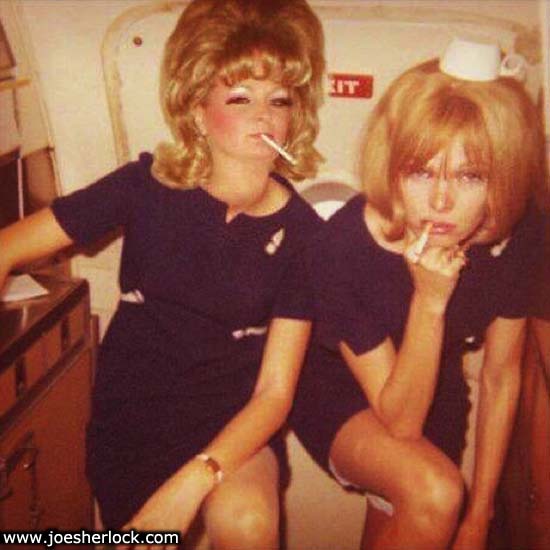
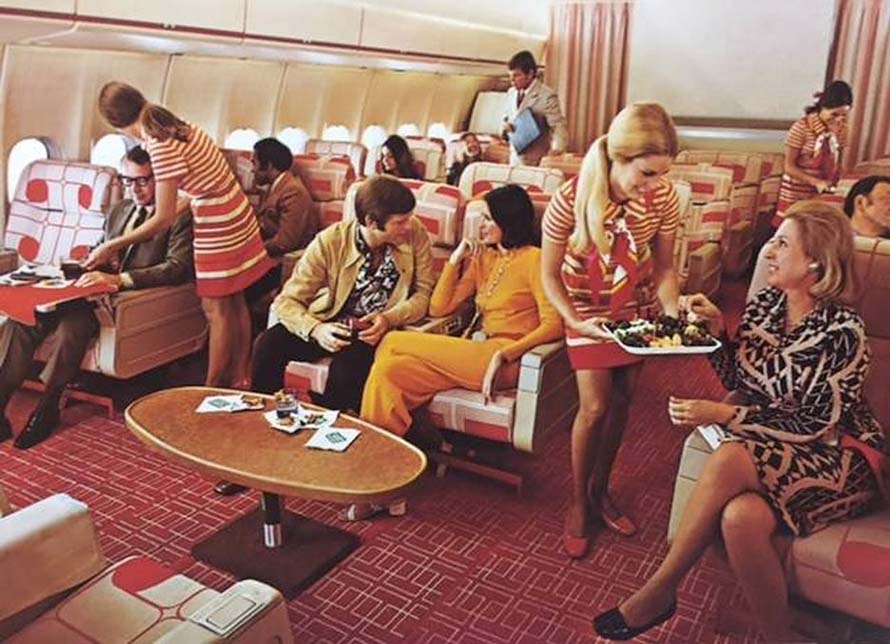
Forty years ago, everyone I knew loved to fly. It was a fun adventure.
Drinks were generous, meals were good and the flight attendants helped make everyone happy. (One cross-country flight actually had a piano on board with a keyboardist-in-residence.)
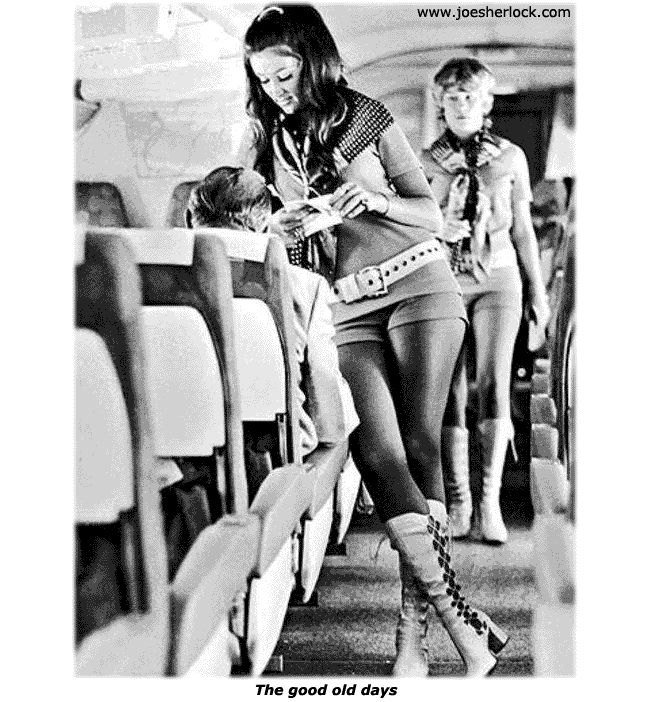
Today, everyone I know hates to fly. It's a stripped-down, unpleasant experience.
A recent lengthy flight on United Airlines featured a First Class 'dinner' offering of a cold turkey sandwich served by a grouchy, uncaring flight attendant. Kind of makes the word 'attendant' an oxymoron, doesn't it? (Based on the reception I received when I asked for a refill of my wine glass, you'd think I asked her to crawl out on the wing and bring back a carafe of hydraulic fluid. And a handful of CherryMax rivets.) It was the final straw, topping off a series of ghastly experiences with this once-great carrier. We no longer fly The Friendly (sic) Skies.
This is no way to run a business. But, the mistakes made by the airlines can be offered as examples of What Not To Do in your own business:
1. Don't get in a price war with competitors. No one wins. If just a few of the airlines had responded to the first round of price-cutting by increasing their services and holding or increasing prices, the industry would be in better shape today. The hotel/motel industry offers a wide range of prices (and amenities) to appeal to distinct market segments - from the $49.99 per night Red Roof Inn/Motel Six segment to the $499.99 per night Four Seasons.
2. If declining margins are a fact of life in your industry, find a more profitable segment or get out. Once again, the hotel/motel and rental car business provide good examples. In major U.S. cities, there are rental car firms that only rent luxury cars. At luxury prices. These firms have given up on playing the apparently-unprofitable $19.95-a-day game. They've exited the low-end of the market and are concentrating on upper-end business, which, presumably, is more profitable.
3. If you cut your services to improve margins, your service-oriented customers will leave and you'll be left with a bunch of customers who only buy on price. And these are the worst kind of customers to have - a bunch of cheapskates with no sense of loyalty. They'll leave the moment a competitor underprices you by a penny. And the idea of airlines charging $25 extra for a paper ticket (which every other business calls a 'receipt') seems to me to be the ultimate outrage from an industry which has lost its way.
Emphasizing service over price remains the best way to differentiate yourself from your competitors while preserving your profit margins.
Remember the old adage: Cut your prices; cut your service; (then you might as well) cut your throat.
Update (1/6/10): United Airlines ranked last along with US Air in the 2009 JD Power survey among traditional carriers as it posted poor results for "reservation experience", "check-in experience" and "costs and fees." "United also ranked last in a recent University of Michigan Ross School of Business consumer satisfaction survey. Research that 24/7 Wall St. examined revealed that employee work satisfaction was very low."
I guess United has yet to learn its lesson.
Update (5/25/16): J.D. Power has published its 2016 customer satisfaction rankings of North American airlines. United Airlines ranked last among legacy airlines. Alaska Airlines was rated best.
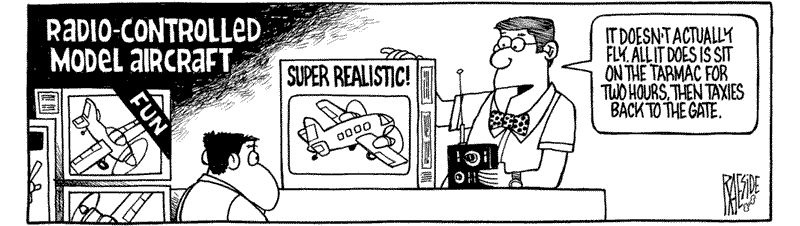
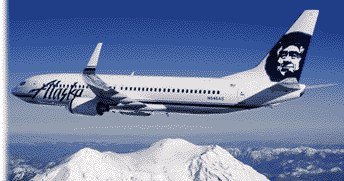 Come Fly With Me: In 2009, airlines experienced the steepest drop in international passenger traffic in the history of modern aviation. According to the International Air transport Association, traffic declined 3.5% in 2009, with the average plane flying less than 76% full. Come Fly With Me: In 2009, airlines experienced the steepest drop in international passenger traffic in the history of modern aviation. According to the International Air transport Association, traffic declined 3.5% in 2009, with the average plane flying less than 76% full.
Since the dawn of commercial flight, domestic paying passenger miles have increased every year with occasional light dips during recessions. In recent years, growth has been stagnant and now it's been dropping. Obviously, the harsh recession is at play but I wonder how much of the drop is due to general suckiness of air travel - stripped down airline services combined with TSA unpleasantness.
In August 2007, 55,681,501 domestic paying passenger miles were flown. By August 2010, that figure had declined to 51,435,574 miles - a drop of almost 8%.
I know we've been flying less. In the prior five years ending in 2005, we flew 50% more air miles than in the most recent half-decade.
We used to travel to Europe every four years or so. Our last overseas trip was to Italy in 2002. We don't plan to visit Europe ever again. But we'll keep our passports updated as we enjoy driving trips to Western Canada.

Much of our lessened travel is due to the disagreeableness of air travel today. When we began flying in 1970, air travel was a delightful experience, which has now disappeared along with evening newspapers, automobile vent windows and polio.
I am expecting our commercial air travel to decline even more substantially in years to come. We now do driving getaways instead. (posted 12-9-10, permalink)
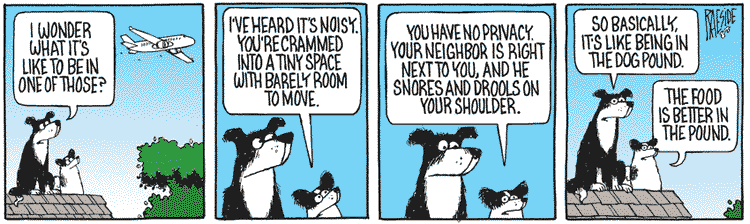
Flying Can Be A Drag: Unless you've been living in a Wi-Fi-less cave for the past several days, you've already seen the video of the ticketed, assigned-and-seated passenger being dragged off a United Airlines flight. Did UA evict him to make room for an emergency surgical team on their way to do a transplant in Louisville? No. Just four deadheading United employees who were on stand-by for a flight to Louisville.
 Well, if they wanted vacancies on a full plane, United should have done the capitalist thing - keep raising the ante until they got four people to accept. The airline offered $800 and got no takers. Why? Because people didn't want to hang around for 24 hours - they value their time. Besides, after you paid for a decent hotel, three meals and a rental car at big-city Chicago rates, most of the eight hundred bucks would have been consumed faster than a lone Krispy Kreme at a Fat Pride convention. All things considered, I bet the get-off-the-plane bribe would have found four takers a level just below $2,000 apiece. In retrospect, that's a mere pittance compared with the seven-figure lawsuits the 'Friendly Skies' will soon face. Well, if they wanted vacancies on a full plane, United should have done the capitalist thing - keep raising the ante until they got four people to accept. The airline offered $800 and got no takers. Why? Because people didn't want to hang around for 24 hours - they value their time. Besides, after you paid for a decent hotel, three meals and a rental car at big-city Chicago rates, most of the eight hundred bucks would have been consumed faster than a lone Krispy Kreme at a Fat Pride convention. All things considered, I bet the get-off-the-plane bribe would have found four takers a level just below $2,000 apiece. In retrospect, that's a mere pittance compared with the seven-figure lawsuits the 'Friendly Skies' will soon face.
Alternatively, United could have had its four employees rent a car and make the four-and-a-half hour drive to Louisville on I-65. "But nooooo!" as the late John Belushi was wont to say. Instead, United saved several thousand dollars and garnered millions in bad publicity, beating up the elderly passenger who was arbitrarily 'selected' by UA's computer.
This was not an isolated incident. Recently, a United Airlines full-fare, first-class passenger was threatened with handcuffs if he didn't relinquish his seat. Then there's my friend Steve, a United Million Miler, who was ordered off a plane because an especially-surly stewardess said he "had an attitude." Steve is a laid-back senior and not an Attitude Guy. Perhaps UA's slogan should be 'Fly The Fascist Skies'.
Gerard Van der Leun wrote, "If there was ever a boycott that all sides of the American argument can agree on, this is it. United Airlines needs to auger nose first into the ground at max speed. It's a criminal operation and never to be trusted again." Fair comment, Gerard. But, as often happens, the Sherlocks were ahead of the curve. We threw in the towel with United Airlines almost 15 years ago. I had been traveling on United since the late 1960s and personally witnessed a once-great carrier degrade into a flying pile of shit.
United has earned its bad rep many times over. And, sadly, passengers who choose United these days deserve what they get. (posted 4/13/17, permalink)
Is It 'Fly United', Or Will It Be 'Die United'? At least half of the 5,000 students United Airlines hopes to train by the end of the decade "will be women and people of color." Currently, about 7% of United's pilots are women and 13% are people of color.
I don't want Quota Pilots. I want skilled professionals who prioritize my safety. I don't care about their sex, skin color or ethnicity. Just give me the best. Is that too much to ask?
PS: We quit flying United Airlines in 2003. (posted 4/20/21, permalink)
Other Pages Of Interest
copyright 2003-21 - Joseph M. Sherlock - All applicable rights reserved
Disclaimer
The facts presented on this website are based on my best guesses and my substantially faulty geezer memory. The opinions expressed herein are strictly those of the author and are protected by the U.S. Constitution. Probably.
Spelling, punctuation and syntax errors are cheerfully repaired when I find them; grudgingly fixed when you do.
If I have slandered any brands of automobiles, either expressly or inadvertently, they're most likely crap cars and deserve it. Automobile manufacturers should be aware that they always have the option of trying to change my mind by providing me with vehicles to test drive.
If I have slandered any people or corporations , either expressly or inadvertently, they should buy me strong drinks (and an expensive meal) and try to prove to me that they're not the jerks I've portrayed them to be. If you're buying, I'm willing to listen.
Don't be shy - try a bribe. It might help.
|
|