Which Era? 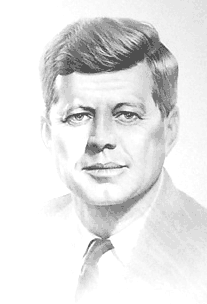 I enjoy most of Hugh Hewitt's writings but must respectfully disagree with his 2004 article in The Weekly Standard. Hugh posits that The Sixties began with the election of John F. Kennedy. "The Sixties ended on September 11, 2001, but they were interred on the morning of November 3, 2004, when a senator from Massachusetts played the reverse role of another senator from Massachusetts 44 years earlier."
Hugh writes that when John Kennedy won, "it set in motion events that would pummel America and its politics right through this just-completed campaign. The triumph of Jack Kennedy elevated style, new money, and a new elitism into the mainstream. It launched a war that would divide the country as none before - excepting the Civil War - had. It led to the credentialing of a media elite just now beginning a long overdue mass retirement. And it set in motion a swirl of cultural change that would culminate in the bipolarization of the political world into red and blue."
It is my opinion that JFK was part of The Fifties - a magical era that spanned a period of sixteen years, from October 14, 1947 to November 22, 1963 ... (more >>>)
Personal Reflections: On a sunny Friday afternoon in November 1963, I was leaving a college classroom after taking a thermodynamics exam. In the hallway, the professor pulled several students aside and whispered, "The president's been shot in Texas." He had no further details, so I hurried to the parking lot, hopped in my red VW Beetle and clicked on the radio, waiting for the tubes to warm up.
I headed for home. Just as I got on the Schuylkill Expressway, JFK's death was announced. Not knowing what to do, I turned on my headlights. As did most of the other cars on the road.
I liked John F. Kennedy. He was young and a fresh break from the old, fuddy-duddy, grandfatherly Presidents like Ike and Truman. I remember the excitement when he was campaigning for the presidency.
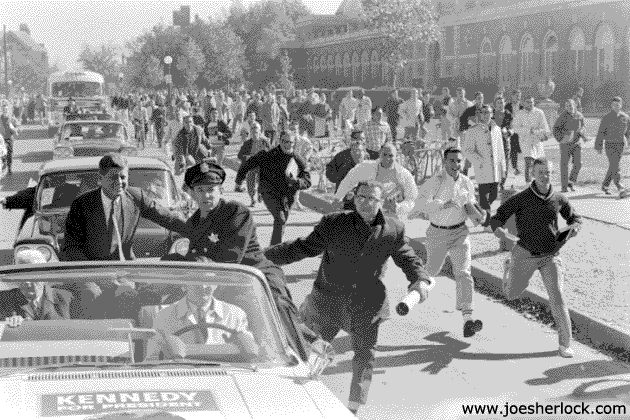
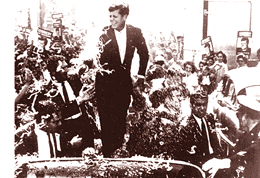 In October of 1960, a friend and I fastened a Kennedy-for-President poster to the front of my dad's 1956 Ford and we drove up Frankford Avenue (in Northeast Philadelphia) about 500 yards ahead of the convertible (a Buick, I think) in which candidate JFK was riding. (Try breaking into a Presidential candidate's motorcade today. You'll be quickly gunned down by Uzi-wielding Secret Service agents.)
My parents were big JFK fans, too. He was a Democrat, Irish, Catholic ... he was us.
Chris Matthews also believes that the assassination of John F. Kennedy marked the beginning of the Sixties. He says they "were sparked by the grief engendered by our loss of JFK." That's not what I believe. The don't-trust-the-government (or, as they say in the South, gum-mint), might-as-well-do-something-different-cuz-everything’s-all-screwed-up-anyway Sixties was initiated by the attempts by the government (with the press in the cheering section) to wrap up the JFK's murder in a tidy little package as quickly as a Perry Mason episode.
The gum-mint "solved" the murder before JFK was even in the ground (and made sure that the lone official suspect was conveniently and quickly disposed of) but no one really believed that a chinless little wimp with a cheap rifle could pull off such a thing.
People began to lose trust in the gum-mint. And grew long hair and protested about everything.
Every November 22nd, the networks feature JFK assassination tidbits, interviewing aging people with failing memories. Honestly, I'm tired of hearing about the assassination; everything is a rehash of stale old facts and rumors. Nobody has anything new to say - like who really killed John Kennedy.
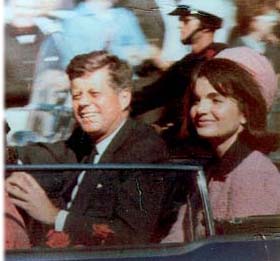 Dallas put an end to JFK the Man. His promise was unfulfilled, his administration unfinished. But JFK the Legend, was born on that November afternoon. Some television segments focus on "what might have been," dragging out the old stories that Kennedy would have pulled us out of Vietnam, put men on the surface of Mars, balanced the budget and invented anti-gravity. Nonsense.
The reality is that JFK was a charismatic but imperfect President. He probably would have been reelected but would continued to be dogged by a recalcitrant Congress - as most Presidents experience. But he lives on in our memories as a man with great ideas, pursued with "viggah!"
Writer/commentator Cal Thomas wrote eloquently about John F. Kennedy: "For some, all things seemed possible with Kennedy in the White House. When he died, most things seemed impossible. There was a sense we had been robbed of hope and hope denied produces cynicism and despair, two viruses that continue to plague our culture.
Speaking as one who became a conservative and realizes that the 'myth' of Camelot was exactly that, I still miss him. Even more, I miss much that was good in American life that seems to have perished with him."
Rest In Peace, Jack.
Remembering Camelot: It seemes like yesterday, but ... (more >>>)
The Kennedy Lincoln ... here.It was perfect matching and perfectly contrasting.
President Eisenhower wore hats and he was chauffeured around town in a big and bulbous black 1950 Lincoln Cosmopolitan limo. It made sense. Ike was a white-haired, bald, kindly old guy with glasses. We all had grandfathers like that. They wore hats and had 10 year-old cars. And they were married to grandmotherly-looking women - like Mamie.
Then Jack Kennedy came along - what a contrast! No glasses, no hat, a head full of rich brown hair, a hot-looking, multilingual, cosmopolitan babe of a wife. So, it made perfect sense that they'd match this President up with a new kind of car - not some big old chrome-laden whale but a modern car with clean lines - a sophisticated car to fit the kind of guy Jack was.
It was called ... (more >>>)
Other Pages Of Interest
| blog: 'The View Through The Windshield' |
| greatest hits: essays & articles | blog archives | '39 Plymouth | model train layout |
| about me | about the blog | e-mail |
copyright 2002-20 - Joseph M. Sherlock - All applicable rights reserved
Disclaimer
The facts presented on this website are based on my best guesses and my substantially faulty geezer memory. The opinions expressed herein are strictly those of the author and are protected by the U.S. Constitution. Probably.
Spelling, punctuation and syntax errors are cheerfully repaired when I find them; grudgingly fixed when you do.
If I have slandered any brands of automobiles, either expressly or inadvertently, they're most likely crap cars and deserve it. Automobile manufacturers should be aware that they always have the option of trying to change my mind by providing me with vehicles to test drive.
If I have slandered any people or corporations, either expressly or inadvertently, they should buy me strong drinks (and an expensive meal) and try to prove to me that they're not the jerks I've portrayed them to be. If you're buying, I'm willing to listen.
Don't be shy - try a bribe. It might help.